
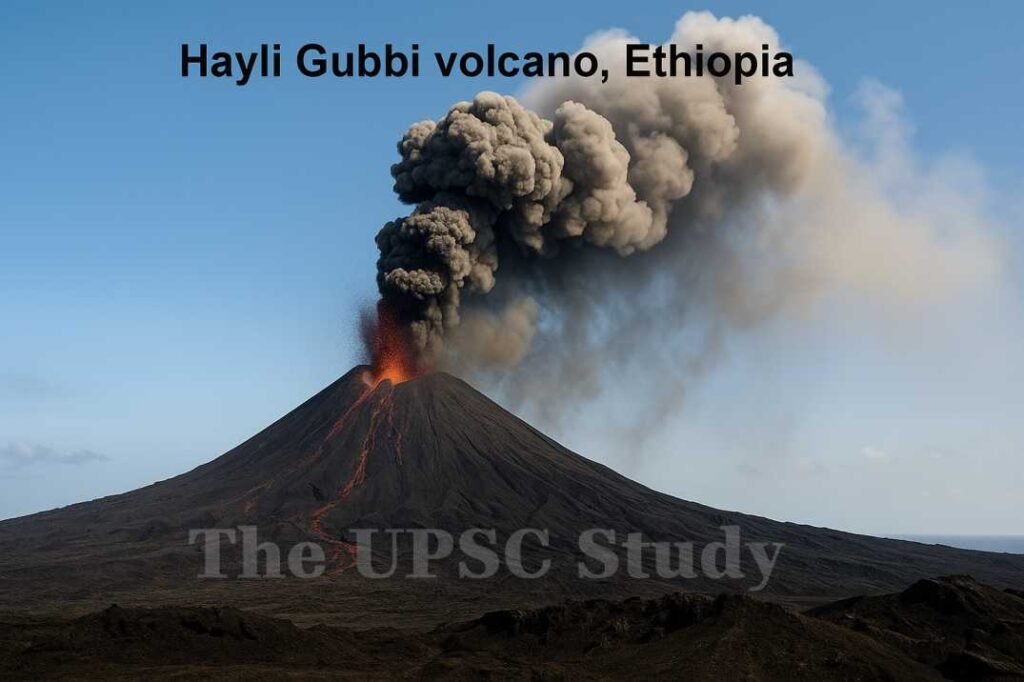
In recent news, on Sunday, November 23, 2025, a stunning natural event unfolded: the Hayli Gubbi volcano in Ethiopia, located in the remote Afar region, experienced a significant eruption. This eruption was particularly notable as it was the first confirmed major activity in the region in approximately 12,000 years. The event was highly explosive, propelling ash plumes up to 14 kilometres high. The sheer force of the explosion suggests it behaved like a composite volcano producing acidic (gas-rich) magma, where the immense pressure from trapped gases beneath the Earth’s surface—the fundamental reason for the explosion—was finally released, a defining feature of powerful volcanism.
The massive volume of ejected pyroclastic materials and fine ash from this act of volcanism has raised significant concerns. Once the ash and sulfur aerosols reached the upper troposphere and lower stratosphere, their stratospheric spread towards the Indian Ocean, India and South Asia, and eventually the China Sea is primarily driven by the Subtropical Jet Stream (STJS). This powerful, high-altitude wind current acts as a fast conveyor belt, facilitating the rapid, long-distance transport of volcanic material globally, potentially impacting air quality and weather patterns across the region.
With this extraordinary event of volcanic eruption, we shall learn about what volcanism is, the forces that drive it, and its profound impact on our planet, in the succeeding part. Understanding volcanism is key to appreciating Earth’s dynamic geology.
Table of Contents
What is Volcanism?
Volcanism refers to all geological processes through which molten rock (magma), gases, and ash escape from the Earth’s interior to its surface. It includes volcanic eruptions or volcanoes, lava flows, gas emissions, and the formation of volcanic landforms such as cones, calderas, and lava plateaus. Volcanism is driven by heat and pressure inside the Earth, particularly at tectonic plate boundaries and hotspots. These processes shape the planet’s crust, influence climate, and create fertile soils, while also posing natural hazards. Technically, a volcano is not a mountain; that mountain must have a mass of rocks lying underneath. Like earthquakes, volcanoes are also a catastrophic type of endogenetic force. In simple terms, volcanism is the Earth’s way of releasing internal heat and reshaping its surface over time.
Causes of Volcanism
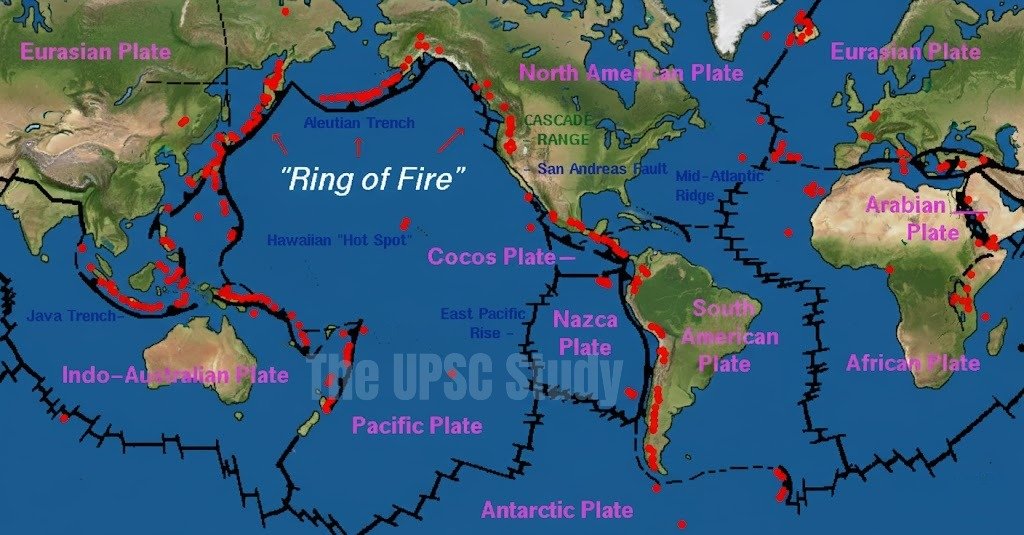
The underlying causes of volcanism are related to the Earth’s internal heat and plate tectonics:
Heat Generation: Chemical reactions of radioactive substances deep within the Earth’s interior generate tremendous amounts of heat. Some residual heat (heat captured at the center during Earth’s formation) is also present.
Convection Currents: A huge temperature difference between the inner and outer layers of the Earth, due to differential radioactivity, gives rise to convectional currents in the outer core and the mantle/asthenosphere.
Plate Tectonics (Divergent Boundary): Convectional currents create divergent (constructive) boundaries. At these boundaries, molten, semi-molten, and sometimes gaseous material appears on the surface at the best available weak zone (usually a plate margin).
- This often results in fissure-type volcanism (e.g., Mid-oceanic ridges), releasing basic (basaltic) magma.
Plate Tectonics (Convergent Boundary): At the convergent (destructive) boundary, the subduction of the denser plate melts the lithosphere due to friction, creating magma at high pressure.
- This magma escapes to the surface with great velocity, releasing pressure through explosive eruptions. This magma is often acidic (granitic) due to the melting of silica-rich lithospheric material.
Types of Volcanic Vents
Fissure Vent
A fissure vent is a linear volcanic opening through which lava erupts quietly, usually without explosive activity. These vents may be several meters wide and many kilometres long. Examples include Deccan Traps and Icelandic fissure systems. Lava is usually basaltic and spread across longer area due to low viscosity. This tupe i found in fissure
Conical Vent
A conical vent, such as Mt. Fujiyama, forms steep volcanic cones where eruptions occur through a central opening. These are also called Central type. Composite cones and cinder cones are the examples of conical vent. These are usually explosive in nature with pyroclastic material (gases and ashes) expelled while venting out.
Types of Volcanic cones (Mainly)
Composite Volcano (Stratovolcano)
- Found at destructive (convergent) margins.
- Produced when oceanic plates melt and magma rises through cracks.
- Largest and most destructive.
- Made of alternating ash and lava layers with steep slopes.
- Lava is viscous and acidic; eruptions are violent and infrequent.
- Examples: Volcanoes along the Circum-Pacific Belt (e.g., Mt. Pinatubo).
Shield Volcano
- Occur at constructive (divergent) boundaries and hotspots.
- Gentle slopes with wide bases.
- Basic magma flows long distances due to high fluidity.
- Eruptions are frequent but mild.
- Examples: Mauna Loa, Hawaiian Islands.
Hotspot Volcanism
Some volcanoes form away from plate boundaries due to rising plumes of heat beneath the lithosphere. As plates move, hotspots appear to shift, forming chains like Hawaii. Hotspots are the zone of separation where the oceanic plates spread or separate due to divergence, from where the magma flows out due to rotating convection current in the asthenosphere, as described by Hess in Ocean spread Theory.
Hydrothermal Features: Geysers and Hot Springs
Geysers and hot springs occur where water percolates into porous rocks heated by underlying magma. Under intense heat, water expands into steam, escapes through weak zones, and forms geysers. Major locations include Iceland, New Zealand, Yellowstone, Japan, and Hawaii. These are not particularly part of volcanism, however these are influenced by the temperature generated in the rocks due to volcanic activity.
Lava Types in Volcanism
Andesitic / Acidic / Composite Lava/Felsic
- Highly viscous, light-colored, rich in silica (80–85%).
- Low density due to high content of silica. Presence of Non-Ferro-Magnetic Silicate (SiAL) or Felsic (Feldspar and Silicate).
- Solidifies quickly and forms steep cones. They flow slowly and seldom travel far before solidifying
- Explosive due to vent blockage. expelling many volcanic bombs or pyroclasts.
- Mostly are granitic type lava.
- Forms spines or plugs (e.g., Mt. Pelée).
Basic / Basaltic / Shield Lava/ Mafic
- Fluidic, dark, rich in iron and magnesium, low silica (40–60%).
- Quiet eruptions; flows up to 30 mph. the bottom layer, about 1,000°C (1,830°F).
- less viscous but high density due to presence of ferro-magnesium silicate (SiMa) or Mafic (Magnesium and Ferric).
- They affect extensive areas, spreading out as thin sheets over great distances.
- Creates wide volcanic terrains (e.g., Deccan Traps).
Types of Volcanic Cones
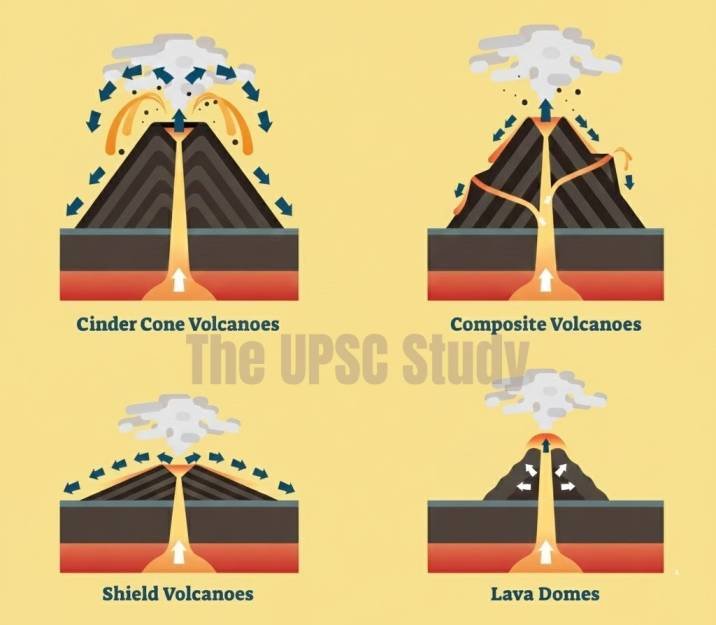
Shield Cone
- Basic magma
- Gentle slopes
- Icelandic / Hawaiian eruptions
- Least explosive
Composite Cone
- Intermediate to acidic magma
- Tall, steep, alternating ash-lava layers
- 3700+ m height
- Eruption styles: Strombolian → Vulcanian → Pelean → Plinian
- Moderately to highly explosive
Cinder Cone (Scoria/Pyroclastic)
- Felsic to intermediate magma
- Height < 500–600 m. Less steeper than composit.
- Loose pyroclasts around vent called Scoria.
- Strombolian eruptions
- Highly explosive
Hybrid (Composite–Cinder Cones)
- Mix of lava flows and pyroclasts
- Intermediate magma
- Moderate to high explosiveness
Eruptive Styles (Least to Most Explosive)
There are 6 types of examples of eruptive style in volcanism.
- Fissure / Icelandic
- Hawaiian
- Strombolian
- Vulcanian
- Pelean
- Plinian
Classification of Volcanism
Based on Number of Eruptions
- Monogenetic: One-time eruption (e.g., cinder cones).
- Polygenetic: Multiple eruptions (composite, shield).
Based on Post-evacuation Build-up
- Constructional: Formation of a cone or tube (e.g., Cinder, Composite, Shield).
- Excavational: Negative relief due to collapse of the vent (e.g., Calderas, Tuff Rings).
Based on Frequency of Eruption
- Active volcanoes: Which erupts frequent number of times and Currently erupting or showing signs of unrest (earthquakes, gas emissions, ground deformation). Has an active and connected magma chamber below the surface. Erupted in the recent past (often defined as within the last 10,000 years, or within recorded human history). Examples, Mt. Etna (Italy), Kīlauea (Hawaii), Mt. Stromboli (Italy).
- Dormant Volcanoes: Not currently erupting or showing major unrest, but with the potential to erupt again. Have probably not erupted for a very long time (e.g., thousands of years) but is considered capable of future activity. connected magma chamber below the surface.
They may have a magma supply, which may be temporarily inactive or less pressurise. Examples, Mt. Fuji (Japan), Mt. Vesuvius (Italy), Yellowstone Caldera (USA). - Extinct Volcanoes: No eruption for tens or hundreds of thousands to millions of years. The magma supply has been cut off, cooled, and solidified into solid rock. Examples, Edinburgh Castle rock (Scotland), Mt. Thielsen (Oregon, USA).
Lava Flow Types in Volcanism
- Aaaa..: Thick Mafic basaltic lava contains broken lava rocks and debris. Found in Shieldic and fissure type. Less flowy, denser.
- Pahoehoe: Similar to Aaa, i.e. Mafic Basaltic, but less dense and more flowy (continuous).
- Block Lava: less flowy, highly viscous and acidic. Found in Andesitic or stratovolcanoes.
- PILLOW LAVA: lava spread inside ocean and sea, shaped into round blobs, appearing like pillows.
- Lehar – A violent type mudflow & debris flow of Pyroclastic Slurry, Slurry of pyroclastic particles and, sand and muds Sediment.
Landform created in Volcanism
Extrusive Volcanic Landforms
Shield Type Landforms: Formed by very fluid basaltic lava, resulting in broad, gently sloping volcanic islands (e.g., Mauna Loa, Hawaii; Volcanic islands like Andaman and Nicobars).
Fissure Type Flood Basalt Landforms (Lava Plateaus): Thin magma escapes through cracks and spreads over a vast area, producing a layered, flat surface (e.g., Deccan Traps, Peninsular India).
Cinder Cones: Steep conical hills of loose pyroclastic fragments (pyroclasts), typically less than 600m high (e.g., Rinjani, Indonesia).
Composite Cones: Steeper with a higher cone height than cinder cones, formed along convergent plate margins, resulting in granitic/felsic rocks.
Calderas: A cauldron-like crater formation resulting from the collapse of a volcano after the magma chamber is emptied by a large explosion or non-explosive collapse (e.g., Barren Island).
- Caldera Lake: A crater filled with water (e.g., Lonar Lake, Maharashtra).
Lava Dome: A circular mound resulting from slow, highly viscous lava formed from explosive volcanoes.
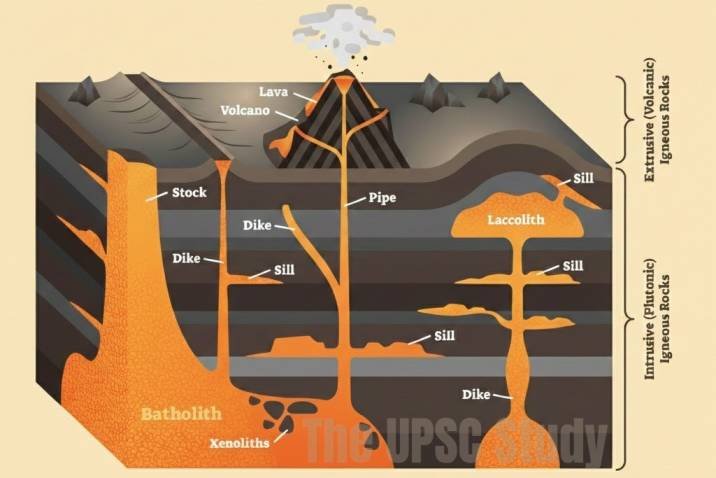
Intrusive Volcanic Landforms
These landforms are created when magma cools and solidifies within the crust (Intrusive Igneous Rocks or Plutonic rocks).
Intrusive Igneous rocks layer of formation
- Plutonic Rocks- form below the basal layer of the rock, extreme below the craton on the continental plate. Example- Batholiths. These are highly metamorphic. Example Gabrro rocks.
- Hypabassal Rocks: rock between lower & upper layer (less than 2km of crust). Low metamorphosis of rock e.g. Laccolith, Lopolith, Phacolith.
Batholiths
- Large granitic bodies forming core of mountains. Large, dome-shaped rock masses (granitic bodies) formed deep within the crust, forming the core of huge mountains.
Laccoliths
- Large, dome-shaped intrusive bodies with a convex arch (bulging upward, like an anticline).
- Seen in Karnataka granite domes.
Lopoliths
- Saucer-shaped intrusive bodies, concave to the sky (opposite of laccoliths, like a syncline).
Phacoliths
- Wavy masses of intrusive rocks found at the base of synclines or top of anticlines in folded igneous layers.
Sills
- Solidified horizontal lava layers within the Earth. Thicker ones are called sills; thinner are sheets.
Dykes and Bosses
- Lava solidified almost perpendicular to the ground, forming a wall-like structure. If angled at 90°, it’s called a Boss.
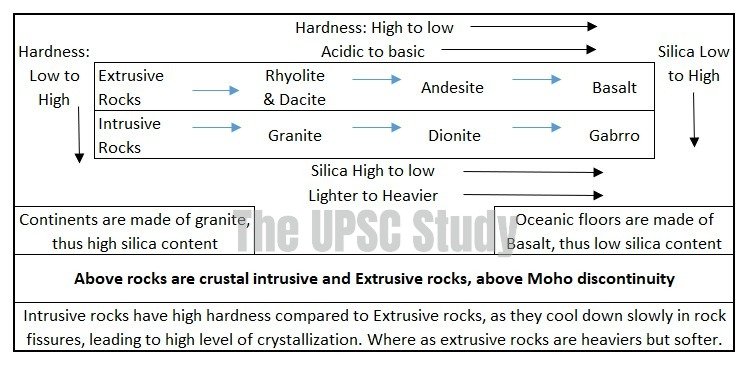
Note: Both extrusive & intrusive rocks in volcanism can be formed by acidic/felsic lava as well as basic/mafic lava depending on the content of Silica. If Lithospheric rock melts, forms granitic/acidic/felsic magmas forms, whereas when asthenosphere melts forms basic/basaltic/mafic magmas. eg., Granite is intrusive but acidic & Gabbro is intrusive but basic. Similarly, Rhyolite is extrusive but acidic & basalt is extrusive & basic. Moreover, Granitic magma are acidic & linked to crust, convergent boundary as at Subduction zone, lithosphere is rich in silica form volcanoes forming the ‘Shields’, where as basic or basaltic magmas are basic & linked to divergent boundary as they break out from the rift and magma oozes out from asthenosphere (along the Hotspot) and Spread out over the ocean beds forming ridges, such as great Atlantic ridge, Indian Ocean ridge.
Types of pyroclastic materials formed in Volcanism
- Pyroclastic gas: It contains 70% water vapour, rest of percentage contains carbon dioxide, sulphur dioxide, silicon dioxide, etc.
- Volcanic ash: pyroclastic grains less than or equal to 2 mm of diameter.
- Volcanic fine ash or Tuff: grains less than 0.063 mm
- Block: Pyroclast grains with diameter more than 64 mm (2.5 inches), angular and pointed in shape.
- Bomb: large rocky substance, similar to Block, diameter again more than 64 mm but round or ellipsoid in shape.
- Lapili (Lapilis): grains with diameter between 2mm to 64 mm.
- Tephra: when volcanic ashes, carried by wind or water, deposits in a waterbody ending up solidifying into a rock structure.
- Ignimbrite: when same ashes deposit on land and accumulate to form a dome like structure.
- Spatter: when molten bomb or block accumulate forming into a rock. Thus, Tephra and Ignimbrite are types of spatters.
- Pumice: Light colour vascular and rough textured volcanic rock, formed due to accumulation of ashes and gases. These contain silica material and are lighter in density than water.
- Scoria: highly vesicular, dark-coloured volcanic rock, similar to Pumice, formed by ejection from a volcano as a molten blob and cooled in the air to form discrete grains called clasts. Scoria has relatively low density, as it is riddled with macroscopic ellipsoidal vesicles (gas bubbles), but in contrast to pumice, scoria usually has a specific gravity greater than 1 and sinks in water.
- Hyaloclastite: these are volcanic glasses when lava is quenched by water, such as sea or ocean forming an amorphous solid of silica. Such as Sideromelane glass, Tachylyte glass.
- Pele’s Tear or Pele’s hair: Small droplets of volcanic glass or hyaloclastite, shape like glass beads at the head and thin thread like formation at the tail. Head is too head to break until a slight hit is made at the tail, after which the entire glass shatters.
- Monadnocks / Inselberg: Isolated rocks/hills Standing in a level plain. Layered around the intrusive rock (igneous) by Sedimentary rocks, appearing like a tower. eg., Devil’s tower, Wyoming.
Lava composition in volcanism
- Granitic magmas are also called Felsic (Feldspar+SiO2) magma (Si > 66%)
- Andesitic magmas are called intermediate (54 – 66% Si)
- Basaltic magmas are Mafic (44 – 54% Si). Magnesium + Ferric.
- Peridotite magma (ultrabasic) are ultramafic (< 44% Si).
Types of Silicate minerals in Volcanism
- Non-Ferro Magnesium Silicate (NFMS)– These are FelSic (Feldspar and Silicate) minerals. Main composition of Granitic lava or intrusive type lava. It is the main constituent of Continental crust as it contains Aluminium Tectosilicate (SiAL composition) mineral such as:
- Feldspar- Plagioclase (Na+), Orthoclase (K+)
- Quartz (SiO2)
- Muscovite
- Andesite
- Ferro-Magnesium Silicate (FMS): These are MaFic (Magnesium and Ferrus) minerals. Main composition of Basaltic lava or extrusive type lava and main constituent of oceanic crust and upper mantle. It contains Magnesium silicate (SiMa) minerals such as:
- Biotite (Oceanic crust)
- Augite
- Peridotite (Upper mantle; feldspar <10%)– Pyroxene (Pyroxenite) and Olivine (Dynite and Granet).
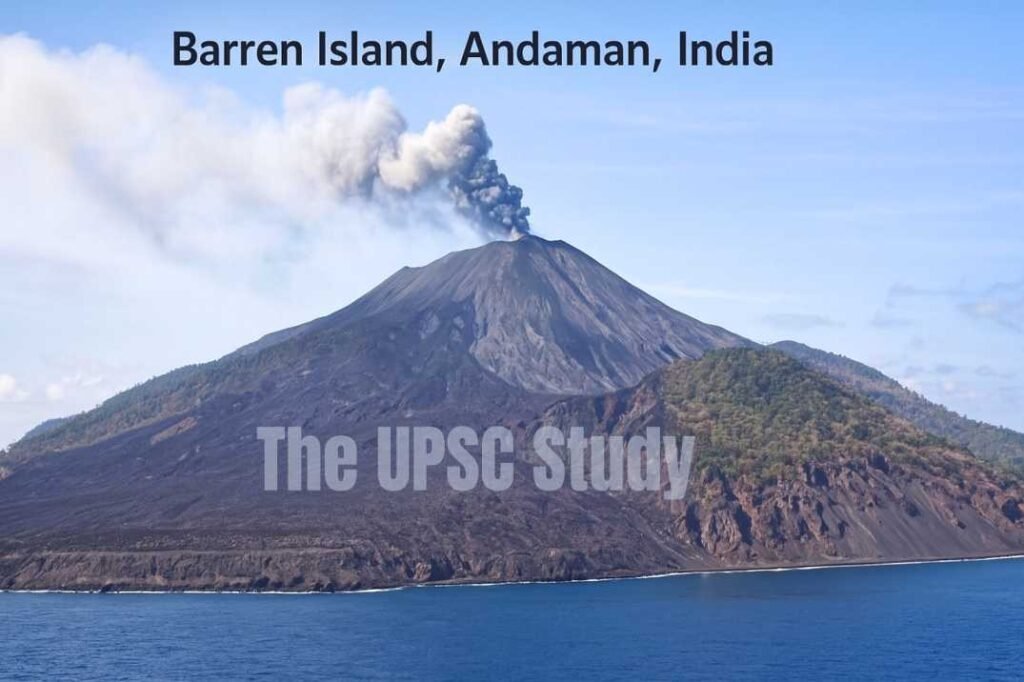
Volcanic landform in India
- Eastern volcanic Islands →
Barren Island and Narcondam Island (only active volcanoes),
Dead Volcanoes
- → Deccan Trap (fissure type, dark/basic, eruption)
- → Doshi hills – Aravalli, Haryana
- → Dhinodhar hills – Gujarat, Kutch
- → Tosham hills – Aravalli, Har
- → Loktak lake, Manipur
Mud volcanoes
- Baratang – Mud volcano (Aandaman islands)