
Teghaza 001: The 4.1-Billion-Year-Old Martian Meteorite That Could Rewrite Our Understanding of Mars
Introduction: A Piece of Ancient Mars Discovered in the Sahara
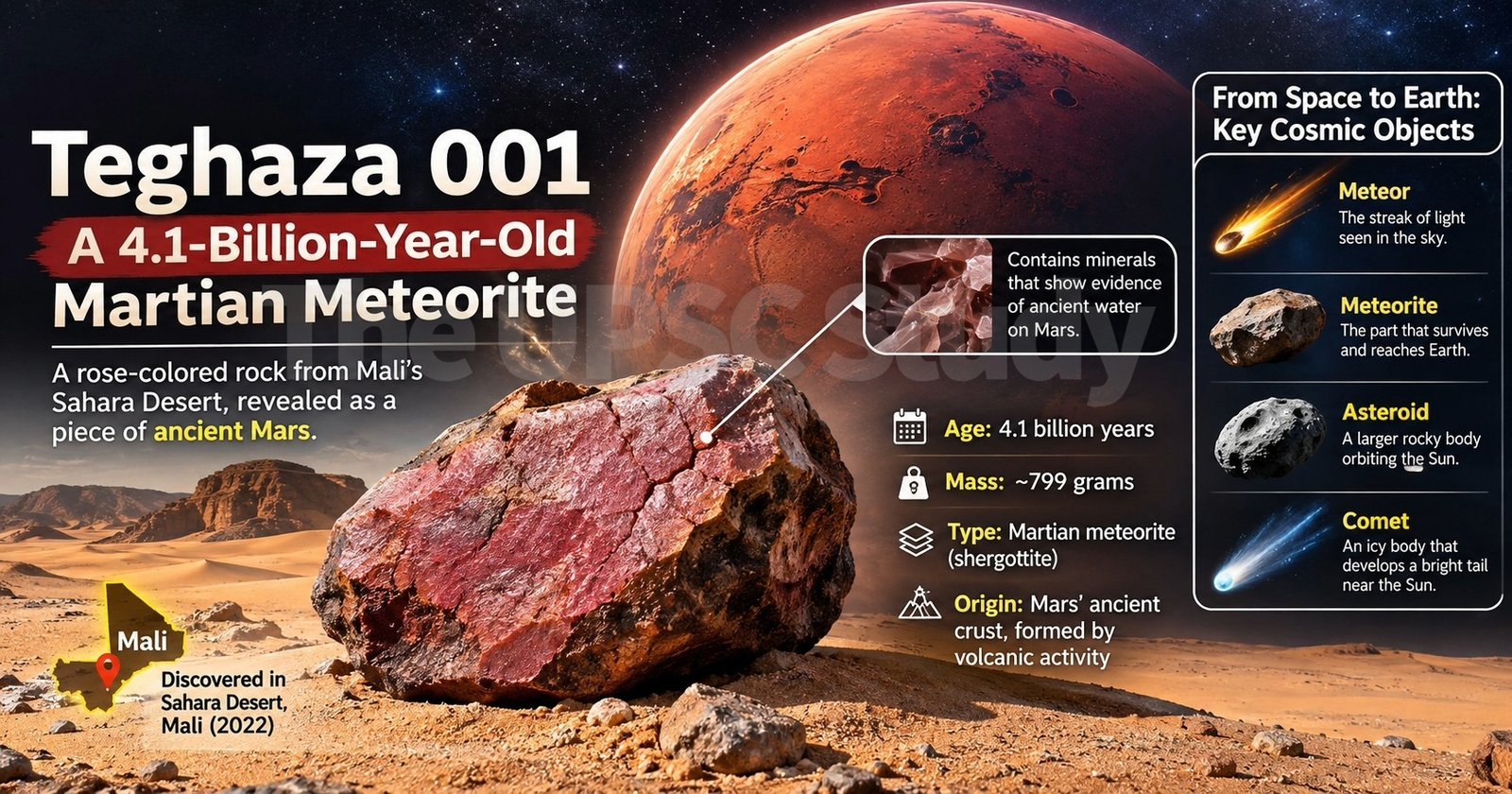
The discovery of an unusual rose-coloured rock in the Sahara Desert has opened another fascinating chapter in planetary science. Scientists have identified the object, named Teghaza 001, as one of the oldest Martian meteorites ever recovered on Earth. Discovered in Mali in 2022, this nearly 800-gram extraterrestrial rock preserves evidence of geological processes that occurred on Mars more than 4.1 billion years ago.
The research, supported by NASA-funded scientists and involving researchers from several scientific institutions, has attracted considerable attention because of what the specimen reveals about the early Martian environment. Unlike many previously identified Martian meteorites, Teghaza 001 contains a distinctive combination of minerals that provides information about the planet’s ancient crust, volcanic activity and interaction with water.
The discovery also highlights the scientific importance of Meteors and Meteorites. Objects that appear as brief streaks of light in Earth’s atmosphere can sometimes leave behind physical samples containing information about planetary formation, geological evolution and even the conditions that existed billions of years before human civilisation.
Table of Contents
1. Teghaza 001: Understanding the Discovery
1.1 Where was Teghaza 001 discovered?
- Location: Sahara Desert, Mali, West Africa.
- Discovery year: 2022.
- Mass: Approximately 799 grams.
- Classification: Martian meteorite, specifically a shergottite.
- Age: At least 4.1 billion years, with evidence of ancient water-related alteration.
- Name origin: Named after the Teghaza salt plain in Mali.
The meteorite was discovered during an expedition by Sahrawi meteorite hunters in September 2022. Its unusual appearance and physical characteristics eventually attracted the attention of researchers.
Initially, scientists did not fully understand its geological significance. However, laboratory investigations revealed that its mineral composition and oxygen isotopes were consistent with material originating from Mars.
The identification was particularly important because meteorites originating from other planets are exceptionally rare. Although thousands of extraterrestrial rocks have been recovered, only a small proportion can be confidently traced to Mars.
1.2 Why is this meteorite scientifically important?
Teghaza 001 is significant for several reasons:
- Ancient geological history: It provides a sample of the Martian crust dating back to the earliest stages of the planet’s development.
- Evidence of water: Its mineralogical and chemical characteristics indicate that water interacted with the rock during Mars’ ancient geological history.
- Volcanic origins: Its composition contains a distinctive combination of igneous minerals, suggesting that the original material formed through the cooling and solidification of magma.
- A different geological environment: Its characteristics provide information about an ancient region of Mars that has not previously been represented adequately in the collection of Martian meteorites.
- Planetary evolution: It can help researchers understand how the Martian crust and mantle developed and how water interacted with the planet’s interior and surface.
The importance of this discovery becomes clearer when compared with other ancient Martian meteorites, particularly ALH84001 and Northwest Africa 7034, popularly known as Black Beauty.
1.3 How did scientists determine its age?
Scientists used advanced mineralogical and isotopic techniques to investigate the meteorite.
Some of the important methods included:
- Zircon analysis: Zircon crystals can preserve information about the geological history of rocks. Their uranium content makes them particularly useful for determining geological ages.
- Uranium-lead dating: Uranium isotopes gradually decay into lead isotopes at predictable rates. Measuring these isotopes helps scientists estimate when minerals crystallised.
- Rubidium-strontium dating: Researchers employed an advanced in-situ technique to analyse individual mineral grains rather than dissolving the entire sample.
- Oxygen isotope analysis: Different planetary bodies have distinctive oxygen isotope characteristics. These act as geochemical fingerprints that help identify the origin of extraterrestrial material.
The use of highly precise dating techniques is particularly valuable because meteorites originating from Mars are limited scientific resources. Researchers must preserve as much material as possible for future investigations.
1.4 What does it tell us about ancient Mars?
Approximately 4.5 billion years ago, Mars was undergoing its initial geological development.
The planet experienced extensive volcanic activity, internal differentiation and the formation of its early crust. Teghaza 001 provides evidence of these processes.
Its mineral composition suggests that the original rock formed from cooling magma and subsequently experienced alteration involving water.
This is particularly interesting because modern Mars is predominantly cold, dry and characterised by a thin atmosphere. However, geological evidence collected by orbiters, landers and rovers has increasingly demonstrated that ancient Mars possessed conditions very different from those observed today.
The discovery strengthens the scientific argument that liquid water once played an important role in shaping the Martian environment.
Importantly, evidence of ancient water does not establish that life existed on Mars. It indicates that certain environmental conditions potentially favourable to life may have existed.
2. Understanding Meteors and Meteorites: What Are They?
Before exploring the historical significance of extraterrestrial objects, it is important to understand the terminology.
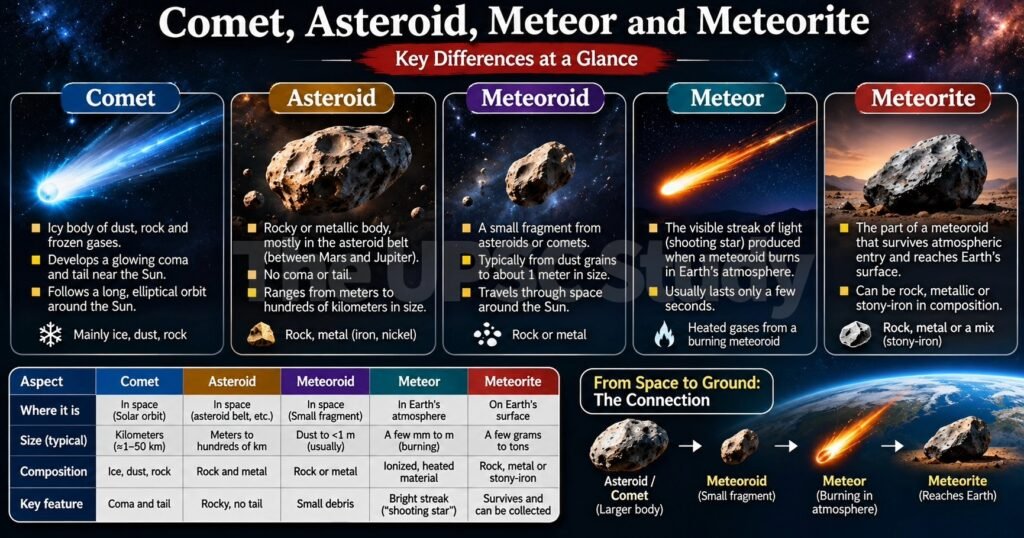
The terms asteroid, meteoroid, meteor and meteorite are frequently used interchangeably in everyday conversations. However, astronomy distinguishes between them according to their physical characteristics, size, location and behaviour.
2.1 What is a meteoroid?
A meteoroid is a relatively small natural object travelling through space.
It may originate from:
- Collisions between asteroids.
- Material released by comets.
- Debris produced during planetary impacts.
- Fragments of the Moon or other planets.
Meteoroids can range from microscopic particles to objects approximately a metre across under commonly used astronomical definitions.
They travel through space under the influence of gravitational forces, following different orbital paths around the Sun.
2.2 What is a meteor?
A meteor is not technically the space rock itself. It is the visible phenomenon produced when a meteoroid enters a planetary atmosphere at high velocity.
When a meteoroid encounters Earth’s atmosphere, it experiences intense compression and heating. The resulting luminous phenomenon appears as a bright streak across the sky.
These are commonly called shooting stars, although they have absolutely no connection with actual stars.
Depending on their brightness, meteors may be classified as:
- Ordinary meteors: Relatively faint streaks of light produced by small incoming particles.
- Fireballs: Exceptionally bright meteors, generally brighter than Venus.
- Bolides: Extremely bright meteors that may undergo fragmentation or explosive disintegration.
2.3 What is a meteorite?
A meteorite is the surviving fragment of an extraterrestrial object that passes through a planetary atmosphere and reaches the surface.
Not every meteor produces a meteorite.
Most incoming particles are destroyed or vaporised during atmospheric entry. Larger or stronger objects may survive partially and reach the ground.
Scientists study meteorites because they provide physical samples of extraterrestrial material that can be examined directly in laboratories.
Unlike distant astronomical observations, laboratory analysis allows researchers to investigate their:
- Chemical composition.
- Mineral structure.
- Isotopic characteristics.
- Geological age.
- Magnetic properties.
- Formation conditions.
This is why meteors and meteorites occupy an important position in planetary science.
3. Difference Between Asteroids, Comets, Meteoroids, Meteors and Meteorites
Although these objects share a common connection with the formation and evolution of the Solar System, their characteristics are considerably different.
3.1 Asteroids
Asteroids are relatively small rocky or metallic celestial bodies orbiting the Sun.
Most known asteroids are concentrated within the main asteroid belt, located between Mars and Jupiter.
Important characteristics:
- Primarily composed of rock, metals and minerals.
- Generally lack the extensive icy composition associated with comets.
- Can range from small irregular objects to bodies hundreds of kilometres across.
- Some possess their own moons.
- Their collisions produce smaller fragments that can eventually become meteoroids.
Asteroids are particularly important because they preserve material left over from the formation of the Solar System approximately 4.6 billion years ago.
3.2 Comets
Comets are small celestial bodies primarily composed of ice, dust, rocky material and frozen gases.
They generally follow elongated elliptical orbits around the Sun.
When a comet approaches the Sun, solar heating causes its volatile materials to sublimate, releasing gas and dust.
This produces two distinctive structures:
- Coma: A cloud of gas and dust surrounding the comet’s nucleus.
- Tail: Material released from the comet and pushed away by solar radiation and the solar wind.
Interestingly, a comet’s tail generally points away from the Sun, not necessarily behind its direction of movement.
Comets are important because their relatively primitive composition preserves information about the cold outer regions of the early Solar System.
3.3 Meteoroids
Meteoroids are smaller fragments of asteroids, comets and occasionally planetary bodies travelling through space.
They represent the intermediate stage between larger extraterrestrial objects and the visible atmospheric phenomenon called a meteor.
3.4 Meteors
Meteors are luminous atmospheric phenomena generated by incoming meteoroids or other sufficiently large extraterrestrial objects.
They are visible because of the intense heating and ionisation associated with high-speed atmospheric entry.
3.5 Meteorites
Meteorites are extraterrestrial fragments that survive atmospheric entry and reach the ground.
They can provide information about asteroids, planetary interiors, volcanic processes and the early Solar System.
3.6 Comparison table
| Object | Primary composition | Location | Defining characteristic |
|---|---|---|---|
| Asteroid | Rock and metal | Space | Relatively large rocky celestial body |
| Comet | Ice, dust and rock | Space | Develops a coma and tail near the Sun |
| Meteoroid | Rock or metal | Space | Small fragment of a larger body |
| Meteor | Luminous atmospheric phenomenon | Atmosphere | Produces a shooting star |
| Meteorite | Rock or metal | Planetary surface | Survives atmospheric entry |
An easy way to remember the distinction:
A meteoroid is in space, a meteor is the light produced during atmospheric entry, and a meteorite is the surviving material that reaches the ground.
4. Scientific Theories Behind the Formation of Meteors and Meteorites
The existence of extraterrestrial rocks is closely connected with the formation of the Solar System and the gravitational interactions between celestial bodies.
Several scientific explanations help us understand their origins.
4.1 Solar Nebula Theory
The Solar Nebula Theory is the widely accepted scientific explanation for the formation of the Solar System.
According to this model:
- Approximately 4.6 billion years ago, a large cloud of gas and dust underwent gravitational contraction.
- Most of its material accumulated at the centre, eventually forming the Sun.
- The remaining material flattened into a rotating protoplanetary disc.
- Dust particles collided and gradually accumulated into larger structures.
- These structures developed into planetesimals and eventually planetary bodies.
However, not all the original material became part of planets.
Considerable quantities remained as smaller rocky, metallic and icy objects.
These remnants eventually developed into the asteroids and comets observed today.
The collisions between these objects continuously generate fragments, some of which become meteoroids.
Consequently, many meteorites represent extremely ancient material that has survived since the earliest stages of Solar System formation.
4.2 The Accretion Theory
Accretion describes the gradual accumulation of smaller particles into larger bodies through collisions and gravitational attraction.
In the early Solar System, microscopic dust particles collided, adhered and formed increasingly large structures.
Over millions of years, these structures developed into planetesimals.
Some eventually became planets, while others remained as asteroids and other smaller objects.
The theory explains why many meteorites contain primitive materials that have undergone relatively little geological modification.
4.3 The Collisional Fragmentation Theory
Asteroids frequently collide with one another.
Depending on their relative velocities, mass and structural strength, these collisions can produce anything from minor surface damage to complete fragmentation.
The resulting debris may enter different orbital paths around the Sun.
Some fragments eventually cross Earth’s orbit.
When they enter Earth’s atmosphere, they produce meteors, and surviving fragments become meteorites.
This mechanism explains why most meteorites recovered on Earth are believed to originate from asteroids.
4.4 The Planetary Impact Ejection Theory
This theory is particularly relevant to Teghaza 001.
How can a piece of Mars travel millions of kilometres through space and eventually reach Earth?
The explanation involves enormous impact events.
The process can be understood through several stages:
- An asteroid or another sufficiently large extraterrestrial object collides with the Martian surface.
- The collision releases enormous quantities of energy.
- Shock waves and impact forces eject fragments of Martian rocks into space.
- Some fragments escape Mars’ gravitational influence.
- These fragments enter independent trajectories around the Sun.
- Gravitational interactions eventually place some of them on Earth-crossing orbits.
- A fragment enters Earth’s atmosphere and, if it survives, reaches the surface as a meteorite.
This is the established scientific explanation for the presence of Martian meteorites on Earth.
The same general mechanism explains how lunar meteorites can reach our planet.
4.5 The Water Delivery Hypothesis
Another interesting scientific question concerns the origin of Earth’s water.
One hypothesis proposes that water-rich asteroids and comets contributed to Earth’s early water inventory through repeated impacts.
However, the exact contribution of these objects remains debated.
Scientists investigate the hydrogen isotope composition of meteorites, particularly the ratio of ordinary hydrogen to deuterium.
Comparing these measurements with Earth’s oceans helps researchers understand whether particular extraterrestrial bodies could have contributed to Earth’s water.
This research also provides a connection between meteors and meteorites and the broader question of how habitable environments developed on Earth.
5. Different Types of Meteorites
Meteorites are broadly classified according to their chemical composition, mineralogy and geological characteristics.
5.1 Stony Meteorites
These are primarily composed of silicate minerals.
They constitute the largest proportion of meteorites recovered on Earth.
Two important categories are:
- Chondrites: Contain small spherical mineral structures called chondrules. Many preserve relatively primitive material from the early Solar System.
- Achondrites: Have undergone geological processes such as melting and differentiation, making them more similar to terrestrial igneous rocks.
Martian and lunar meteorites generally belong to the achondrite category.
5.2 Iron Meteorites
Iron meteorites primarily consist of iron and nickel.
They are particularly interesting because many are believed to originate from the metallic cores of differentiated asteroids.
Their internal crystalline structures can reveal information about cooling rates and the thermal history of their parent bodies.
5.3 Stony-Iron Meteorites
These meteorites contain substantial quantities of both metallic iron-nickel and silicate minerals.
They are relatively uncommon and provide important information about the internal structure of differentiated asteroids.
Two recognised groups are:
- Pallasites.
- Mesosiderites.
5.4 Martian Meteorites
Martian meteorites are fragments of Mars that were ejected into space following powerful impacts.
Scientists identify them through distinctive chemical compositions, mineralogical characteristics and isotopic signatures.
Important examples include:
- ALH84001: An ancient Martian meteorite discovered in Antarctica in 1984.
- NWA 7034 (Black Beauty): A Martian meteorite containing fragments of ancient crustal material.
- Teghaza 001: A recently characterised meteorite providing evidence of ancient Martian geological processes.
These specimens are particularly valuable because they allow researchers to examine Martian material without physically travelling to the planet.
6. Famous Historical Events Associated with Meteors and Meteorites
Throughout history, unusual celestial phenomena have influenced mythology, religion, scientific thinking and planetary research.
Some events have also demonstrated the destructive potential of extraterrestrial objects.
6.1 The Tunguska Event (1908)
Location: Siberia, Russian Empire
Date: 30 June 1908
The Tunguska event remains one of the most powerful naturally occurring atmospheric explosions in recorded human history.
An extraterrestrial object, probably an asteroid or comet fragment approximately 50–60 metres across, entered Earth’s atmosphere and exploded before reaching the ground.
The explosion flattened an estimated 2,000 square kilometres of forest.
Important observations:
- Trees were knocked down over an enormous area.
- The explosion generated powerful atmospheric shock waves.
- No confirmed impact crater was discovered.
- Scientists estimate that the energy released was equivalent to several megatons of TNT.
The event demonstrated that even objects that never reach the ground can cause extensive destruction.
It also contributed significantly to modern planetary defence research.
6.2 The Chelyabinsk Meteor (2013)
Location: Chelyabinsk, Russia
Date: 15 February 2013
The Chelyabinsk event is one of the best-documented atmospheric meteor explosions in modern history.
A relatively small asteroid, approximately 17–20 metres in diameter, entered Earth’s atmosphere at high speed.
It fragmented at an altitude of approximately 23 kilometres.
The resulting explosion released energy equivalent to around 440,000 tonnes of TNT.
Consequences included:
- Thousands of buildings experienced window damage.
- More than 1,600 people sought medical attention, primarily because of injuries caused by broken glass.
- Shock waves were detected across a large geographical region.
- Several meteorite fragments were subsequently recovered.
The event demonstrated that comparatively small asteroids can create significant regional hazards.
It also highlighted the importance of monitoring near-Earth objects.
6.3 The Chicxulub Impact: The Extinction of Dinosaurs
Location: Yucatán Peninsula, Mexico
Approximate date: 66 million years ago
One of the most consequential extraterrestrial impacts in Earth’s geological history occurred approximately 66 million years ago.
A large asteroid, estimated to have been around 10 kilometres in diameter, collided with Earth near the present-day Yucatán Peninsula.
The collision created the Chicxulub crater, approximately 180 kilometres across.
Scientists associate this event with the Cretaceous-Paleogene mass extinction.
Its consequences included:
- Enormous quantities of dust and aerosols entering the atmosphere.
- Reduction in sunlight reaching Earth’s surface.
- Disruption of photosynthesis and food chains.
- Extensive environmental disturbances.
- The extinction of approximately 75% of Earth’s species, including all non-avian dinosaurs.
The Chicxulub impact provides some of the strongest evidence that extraterrestrial collisions have played a significant role in Earth’s biological evolution.
6.4 The Sikhote-Alin Meteorite Fall (1947)
Location: Sikhote-Alin Mountains, Soviet Union
Date: 12 February 1947
The Sikhote-Alin event involved a large iron meteoroid entering Earth’s atmosphere and breaking into numerous fragments.
Witnesses observed a brilliant fireball accompanied by a powerful atmospheric explosion.
The event produced numerous impact craters and scattered thousands of iron meteorite fragments across the surrounding region.
It is particularly important because researchers recovered a substantial quantity of material, providing an opportunity to study the fragmentation behaviour of metallic extraterrestrial objects.
6.5 The Ann Hodges Meteorite Incident (1954)
Location: Sylacauga, Alabama, United States
Date: 30 November 1954
One of the most unusual meteorite incidents in recorded history involved an American woman named Ann Hodges.
An approximately 3.6-kilogram meteorite crashed through the roof of her house, bounced off a radio and struck her while she was resting on a sofa.
She sustained significant bruising.
The incident is widely recognised as the first well-documented case of a person being injured by a meteorite in the United States.
It illustrates how extremely rare direct human injuries from meteorites are.
6.6 The Allende Meteorite Fall (1969)
Location: Chihuahua, Mexico
Date: 8 February 1969
The Allende meteorite is among the most scientifically important carbonaceous chondrites ever recovered.
It fragmented during atmospheric entry and scattered numerous pieces across a large area.
Scientists discovered that the meteorite contained calcium-aluminium-rich inclusions, among the oldest solid materials formed in the Solar System.
Some of these inclusions are approximately 4.567 billion years old.
The discovery provided valuable information about the earliest chemical and physical processes involved in Solar System formation.
7. Meteor Showers: When Earth Passes Through Cosmic Debris
Not every meteor represents a dangerous extraterrestrial object.
Earth regularly encounters streams of dust and small particles distributed along the orbital paths of comets and certain asteroids.
When our planet passes through these streams, numerous meteors become visible within a relatively short period.
This phenomenon is known as a meteor shower.
7.1 How do meteor showers occur?
The process is relatively straightforward:
- A comet travels around the Sun.
- Solar heating releases gas and dust from its surface.
- The released material spreads along the comet’s orbital path.
- Earth periodically crosses this debris stream.
- Small particles enter Earth’s atmosphere.
- They produce numerous luminous streaks, creating a meteor shower.
7.2 Famous meteor showers
Perseids
- Usually peak around August.
- Associated with Comet Swift-Tuttle.
- One of the most popular annual meteor showers.
Leonids
- Usually peak around November.
- Associated with Comet Tempel-Tuttle.
- Famous for producing occasional meteor storms.
Geminids
- Usually peak around December.
- Associated with asteroid 3200 Phaethon.
- Known for their relatively high meteor activity.
Orionids
- Usually peak around October.
- Associated with Halley’s Comet.
Eta Aquariids
- Usually peak around May.
- Also associated with Halley’s Comet.
Meteor showers are generally harmless because most of their particles are extremely small and burn up high in the atmosphere.
8. Comets, Asteroids and Meteorites: Their Role in the Evolution of Life
Beyond their astronomical importance, extraterrestrial objects may have influenced the chemical and biological development of Earth.
8.1 Delivery of Organic Molecules
Scientists have discovered organic compounds, including amino-acid-related chemistry, in certain carbonaceous meteorites.
These discoveries demonstrate that extraterrestrial objects can transport complex carbon-containing molecules.
However, organic molecules are not necessarily biological products.
Their presence does not establish that life originated in space.
8.2 Delivery of Water
Water-rich asteroids and possibly some comets may have contributed to Earth’s water inventory.
Scientists investigate this possibility by comparing the isotopic composition of extraterrestrial materials with terrestrial water.
The evidence suggests that certain asteroid populations could have been important contributors.
8.3 The Panspermia Hypothesis
Panspermia is the hypothesis that life, or its microscopic precursors, might be distributed between planetary bodies through space.
One proposed mechanism is lithopanspermia.
According to this hypothesis:
- An impact ejects rocks from a planet containing microorganisms.
- Some fragments escape the planet’s gravitational field.
- They travel through interplanetary space.
- A fragment eventually reaches another planetary body.
- Under suitable conditions, surviving microorganisms might establish themselves.
Scientists have investigated whether certain microorganisms could survive individual stages of this process.
However, no convincing evidence has established that life has actually travelled between planets through meteorites.
It remains an interesting scientific hypothesis rather than an established explanation for the origin of life.
8.4 The Extinction Hypothesis
Large extraterrestrial impacts can cause extensive environmental disturbances.
The Chicxulub event demonstrates that an asteroid collision can contribute to mass extinction.
However, impacts are not the only cause of biological extinction. Volcanic activity, climate change, changes in ocean chemistry and other geological processes have also played important roles.
9. How Scientists Study and Identify Meteorites
The identification of extraterrestrial material requires more than examining its external appearance.
Many terrestrial rocks resemble meteorites, making laboratory investigation essential.
Scientists generally employ several techniques.
9.1 Chemical Composition
Meteorites contain characteristic combinations of elements, including iron, nickel, silicon, magnesium and other trace elements.
Their elemental composition can help distinguish extraterrestrial material from ordinary terrestrial rocks.
9.2 Isotope Analysis
Isotopes are different forms of the same chemical element with varying numbers of neutrons.
Their relative abundance can provide information about the origin and geological history of a sample.
Oxygen isotope analysis is particularly useful for identifying meteorites originating from Mars and other planetary bodies.
9.3 Radiometric Dating
Radioactive elements decay at predictable rates.
Scientists use these decay processes to estimate the age of minerals and determine when particular geological events occurred.
Important techniques include:
- Uranium-lead dating.
- Rubidium-strontium dating.
- Samarium-neodymium dating.
- Potassium-argon dating.
9.4 Mineralogical Investigation
Researchers use specialised microscopes and analytical instruments to identify mineral structures and chemical characteristics.
These investigations help reconstruct the temperature, pressure and geological conditions under which a meteorite formed.
9.5 Space Mission Comparisons
Scientists can compare meteorite samples with measurements obtained by spacecraft, landers and rovers.
For example, the mineralogical and chemical characteristics of Teghaza 001 were compared with observations of the Martian surface made by NASA’s Mars Reconnaissance Orbiter.
Such comparisons help identify potential source regions on Mars.
10. Future Research: What Could Teghaza 001 Reveal?
The discovery of Teghaza 001 is not the conclusion of research into ancient Mars. Instead, it provides scientists with a new starting point.
Several important research questions remain:
1. Where exactly did it originate?
Scientists have identified multiple potential locations on Mars that match the meteorite’s chemical and mineralogical characteristics. Its precise source region remains uncertain.
2. How widespread was liquid water on ancient Mars?
The meteorite provides evidence of water-rock interactions. Further investigations could help establish how water was distributed through the ancient Martian crust.
3. What was the composition of the early Martian mantle?
Its distinctive chemical characteristics could help researchers understand the planet’s internal differentiation and mantle evolution.
4. Could ancient Mars have supported microbial life?
Water is an essential requirement for life as we know it. However, determining whether ancient Mars actually supported living organisms requires substantially more evidence.
5. What can future Mars sample-return missions discover?
Studying meteorites alongside samples collected directly from the Martian surface could provide a more comprehensive understanding of the planet’s geological history.
Conclusion
The discovery of Teghaza 001 demonstrates why the study of extraterrestrial objects, such as meteors and meteorites, remains fundamental to understanding our Solar System.
A seemingly ordinary rose-coloured rock recovered from the Sahara has provided researchers with an extraordinary opportunity to investigate geological processes that occurred on Mars more than four billion years ago.
From the formation of the Solar System to the possibility of ancient water on Mars, the study of meteors and meteorites connects several major questions in planetary science.
Asteroids and comets preserve material from the earliest stages of planetary formation, while meteorites provide physical samples that scientists can examine directly.
Historical events such as Tunguska, Chelyabinsk and Chicxulub also remind us that extraterrestrial objects are not merely scientific curiosities. They have influenced Earth’s geological and biological history and, in some circumstances, can present substantial hazards.
Ultimately, every meteorite recovered on Earth represents an opportunity to investigate a distant world without necessarily travelling there.
Teghaza 001 is particularly remarkable because it offers a glimpse into a period when Mars was a very different planet—one where volcanic activity, water-rock interactions and potentially habitable environmental conditions were part of its evolving geological landscape.
The more scientists learn from these ancient fragments, the closer humanity comes to understanding the origins and evolution of the planets, including our own.