
Introduction- India EU FTA
On Tuesday, February 2, 2026, India and the European Union (EU) reached a monumental milestone by finalising a comprehensive India EU FTA after nearly two decades of negotiations that began in 2007, the agreement was signed between India and the European Union, two economic blocs that together account for nearly 25% of global GDP. Valued at an estimated $24 trillion, it has been described as the “largest FTA for India till now”, reflecting its sheer economic and strategic scale. The deal was signed in New Delhi by PM Modi, European Commission President Ursula von der Leyen, and Council President António Costa.
Prime Minister Shri Narendra Modi famously termed the India EU FTA the “mother of all deals”, underlining its depth, ambition, and long-term impact. European Commission President Ursula von der Leyen echoed this sentiment, stating that the pact would reduce strategic dependencies amid global uncertainty. The India EU FTA thus goes beyond tariff reduction, positioning itself as a cornerstone of 21st-century economic cooperation.
Table of Contents
Key Features of the India EU FTA
The India EU FTA covers a wide spectrum of goods, services, investment, and regulatory cooperation. It aims to progressively eliminate tariffs, improve market access, and integrate supply chains across manufacturing and services. The agreement spans traditional sectors such as textiles and agriculture, as well as future-oriented areas like AI, semiconductors, clean energy, and advanced manufacturing. Sectoral wise key features are as follow:
Benefits to India
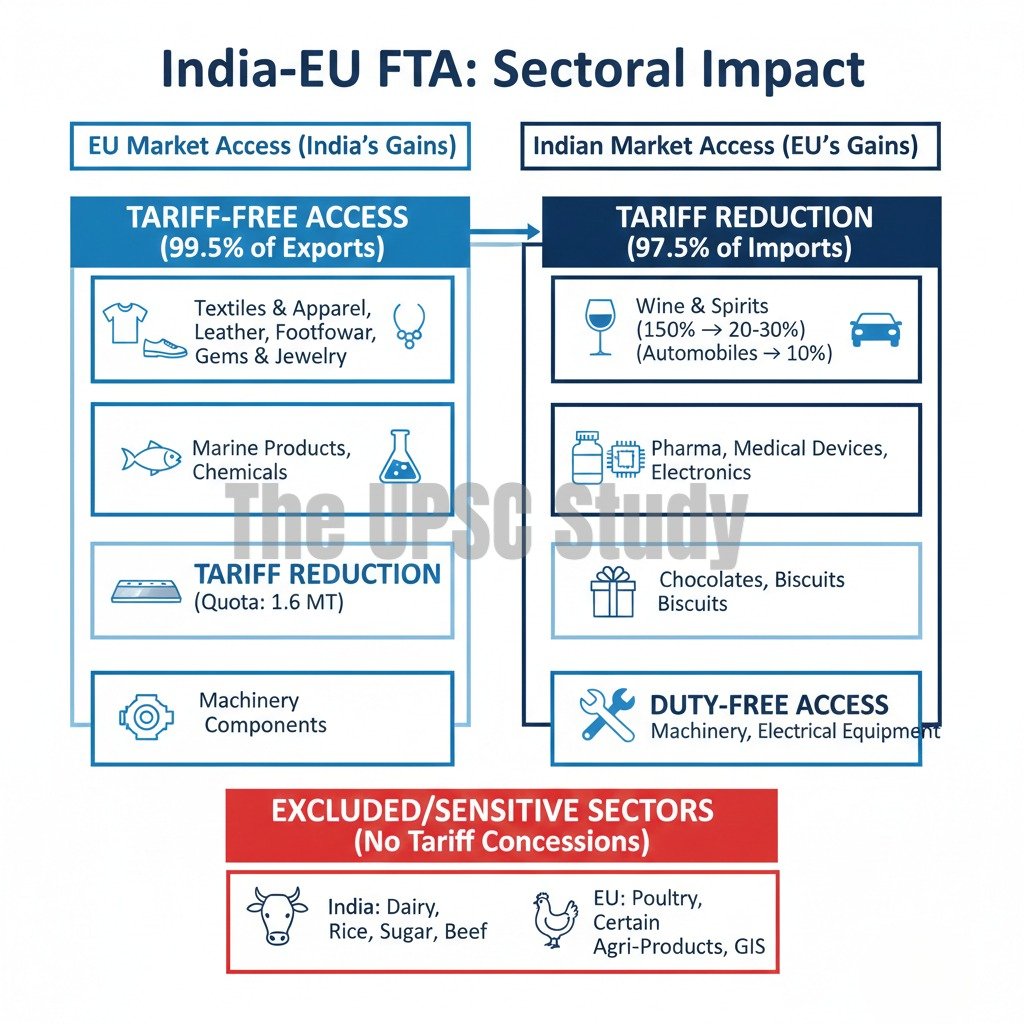
Under the India EU FTA, tariff elimination or reduction applies to nearly 90–99% of Indian export lines to the EU over phased timelines. Around 90.7% of India’s exports will become duty-free by the end of the implementation period.
Key Indian sectors benefiting from duty-free or near-zero duty access include:
- Textiles and apparel
- Leather and footwear
- Gems and jewellery
- Marine products
- Chemicals and plastics
- Engineering goods and machinery
- Automobiles and auto components (phased)
- Pharmaceuticals and medical devices
Labour-intensive sectors, which are crucial for employment generation, stand to gain significantly, improving India’s competitiveness vis-à-vis countries like Bangladesh and Vietnam in the EU market.
Benefits to EU Countries
India has offered tariff elimination or reduction on 97–97.5% of EU imports by value under the India EU FTA. Approximately 49.6% of tariff lines will see immediate duty elimination, with others phased out over five to ten years.
EU sectors gaining enhanced access to the Indian market include:
- Machinery and electrical equipment
- Automobiles and luxury vehicles
- Aircraft and aerospace components
- Chemicals and specialty chemicals
- Pharmaceuticals
- Medical and surgical equipment
- Wines, spirits, and processed food products
This improved access strengthens European manufacturing exports while supporting India’s industrial modernisation.
Excluded and Sensitive Areas
Despite its breadth, the India EU FTA excludes or limits concessions in sensitive sectors for both sides. These include:
- Dairy products
- Certain agricultural commodities (rice, wheat, sugar)
- Government procurement
- Sensitive defence-related items
- Specific energy and raw material segments
India also resisted the inclusion of binding sustainability and carbon border obligations in their strictest form, while the EU retained safeguards under its Carbon Border Adjustment Mechanism (CBAM).
History and Geopolitical Drivers
Negotiations on the India EU FTA began in 2007 but stalled in 2013 due to differences over tariffs, services, and regulatory standards. Talks resumed in 2022 amid shifting global realities.
Several geopolitical and economic factors accelerated the deal:
- Rising protectionism, including US tariffs of up to 50% on certain Indian goods
- The Russia–Ukraine war disrupting energy and supply chains
- High inflation and recessionary pressures in EU economies
- Strategic concerns over US-NATO dynamics and Arctic–Greenland geopolitics
- China’s dominance over rare-earth minerals and semiconductor supply chains
Alongside the India EU FTA, India has pursued parallel trade tracks such as India–UK CETA and India–EFTA TEPA, reflecting a diversified FTA strategy.
Future Speculations and Strategic Spillovers
The India EU FTA is expected to reshape global supply chains by anchoring Indian manufacturers into European value networks. It promotes cross-border movement of services, professional mobility, and collaboration in high-tech domains.
Key future-facing areas include:
- The pact links the European AI Office with India’s National AI Mission to co-develop safe AI and “heterogeneous integration” in chip design.
- Semiconductor manufacturing and advanced packaging
- A new Security and Defence Partnership enhancing cooperation in counter-terrorism and maritime security.
- Civil nuclear collaboration A new India-Euratom Civil nuclear collaboration agreement focusses on the “peaceful uses” of nuclear energy and fusion research (ITER).
- Solar energy, green hydrogen, and climate technologies
- Purchase of 1200 Airbus commercial jet planes in Indian Aviation.
The agreement also complements India’s ambitions in digital public infrastructure and Europe’s regulatory leadership.
Other FTAs Facilitating Indian Exports
The India EU FTA along with FTAs with other European countries, such as the United Kingdom and ETFA, fits into a broader ecosystem of trade agreements aimed at boosting Indian goods and services exports to the European continent. Such two other FTAs follows as:
India–EFTA TEPA
The India–EFTA Trade and Economic Partnership Agreement (TEPA) was signed on 10 March 2024 between India and the European Free Trade Association (EFTA), comprising Switzerland, Norway, Iceland, and Liechtenstein. Established in 1960, EFTA represents one of Europe’s three major economic blocs, alongside the EU and the UK, and serves as a strategic gateway to European markets. It was signed on March 10, 2024, marking a historic milestone as India’s first FTA with a bloc of four developed European nations. The agreement, which officially came into force on October 1, 2025, is a modern and ambitious pact focused on market access, investment, and job creation.
A defining feature of the agreement is EFTA’s commitment of $100 billion in Foreign Direct Investment (FDI) into India over the next 15 years, with the potential to generate one million direct jobs. The agreement aligns closely with India’s Make in India agenda, particularly in infrastructure, manufacturing machinery, pharmaceuticals, food processing, chemicals, transport and logistics, BFSI, and allied sectors.
From a market-access perspective, EFTA offers 92.2% of tariff lines, covering 99.6% of India’s exports, while India provides 82.7% of tariff lines, covering 95.3% of EFTA exports, a significant portion of which relates to gold. The investment commitment, however, is limited strictly to FDI and does not include foreign portfolio investment.
In services, India has offered 105 sub-sectors, responding to wide-ranging offers from EFTA members—128 from Switzerland, 144 from Norway, 110 from Iceland, and 107 from Liechtenstein. The agreement is expected to significantly boost India’s exports in IT, business services, education, personal, cultural, sporting, and recreational services. Importantly, TEPA includes provisions for Mutual Recognition Agreements (MRAs) in professional services such as nursing, chartered accountancy, architecture, and engineering.
At the same time, India has flagged concerns related to intellectual property rights, particularly the risk of patent evergreening and its implications for affordable generic medicines. Strategically, India–EFTA TEPA complements the India–EU FTA by helping Indian firms integrate more deeply into European value chains through advanced, high-income economies.
India–UK CETA
The India–UK Comprehensive Economic and Trade Agreement (CETA) represents another landmark in India’s evolving trade diplomacy. It was signed on July 24, 2025, at the Chequers country estate in Aylesbury, England. Hailed by Prime Minister Keir Starmer as the most significant trade deal for the UK since leaving the European Union, the agreement is projected to double bilateral trade by 2030 and has been described by both sides as ambitious and mutually beneficial.
Under the agreement, around 99% of Indian exports to the UK will benefit from zero-duty access, covering almost the entire trade value. This opens major opportunities for Indian sectors such as textiles and apparel, leather, footwear, gems and jewellery, auto parts, engineering goods, and pharmaceuticals. For the UK, India has agreed to cut tariffs on nearly 90% of tariff lines, with about 85% expected to become zero-duty within a decade.
Key UK exports benefiting from tariff reductions include whisky and gin (tariffs reduced from 150% to 75%, and further to 40% over time), automobiles (tariffs reduced from over 100% to 10% under quotas), as well as cosmetics, aerospace products, medical devices, electrical machinery, salmon, chocolates, and biscuits. These reductions are expected to lower prices for Indian consumers while enhancing competition.
A significant non-tariff gain for India is the Double Contribution Convention, under which Indian professionals working temporarily in the UK and their employers will be exempt from social security contributions for up to three years. This provision directly benefits Indian service providers and professionals, addressing a long-standing concern in mobility and services trade.
Overall, India–UK CETA complements the India–EU FTA by strengthening India’s access to European markets post-Brexit, diversifying export destinations, and reinforcing India’s position as a reliable trade partner amid global economic uncertainty.
Concerns to Other Countries
The India EU FTA reshapes trade preferences in Europe and creates significant economic and strategic concerns for several countries that earlier enjoyed tariff advantages, intermediary roles, or geopolitical leverage.
Pakistan views the agreement primarily as a strategic setback. Deepening India–EU cooperation on trade, security, and counter-terrorism reduces Pakistan’s diplomatic space in Europe and weakens its ability to internationalise bilateral disputes. Economically, Pakistan’s fragile export base faces indirect pressure as Indian goods become more competitive in EU markets.
For Bangladesh, the concern is largely commercial. As a Least Developed Country (LDC), Bangladesh benefited from zero-duty access to the EU, particularly in textiles and garments. The India EU FTA neutralises this advantage by granting Indian apparel and textile exports duty-free or near-zero duty access, threatening Bangladesh’s market share—especially as it moves towards graduation from LDC status.
Turkey faces a structural disadvantage due to the EU–Turkey Customs Union. Ankara is obligated to mirror EU tariff reductions for India, while India is not required to reciprocate. This creates asymmetric trade exposure and weakens Turkey’s competitiveness, particularly amid already strained India–Turkey relations.
The United States is impacted at a strategic level. The India EU FTA reduces Washington’s trade leverage over India, especially after tariff-pressure tactics failed to extract concessions. Preferential EU access places American exporters at a relative disadvantage and signals India’s growing capacity to balance major powers through diversified trade partnerships.
Overall, the India EU FTA redistributes trade advantages and underlines how modern FTAs function not just as economic instruments, but also as tools of geopolitical realignment in a multipolar world.
Conclusion
The India EU FTA is more than a trade agreement—it is a strategic blueprint for economic resilience, technological cooperation, and geopolitical balance. By integrating two major economic blocs, the India EU FTA sets new benchmarks for comprehensive, future-ready trade partnerships in an increasingly fragmented world.