
Uplifting Voices: How the Fundamental Rights in Indian Constitution Preserve Culture and Ensure Remedies
Table of Contents
(fundamental rights in indian constitution)
Cultural and educational rights (Article 29 to 30)
In this set of fundamental rights in Indian Constitution, the state is ordered to make provisions by law for those community and individuals who are linguistically or religiously minor in population to preserve and maintain their culture by practice or setting up institutions, without infringing their rights against any kind of discrimination.
(fundamental rights in indian constitution)
Article 29: Protection of Cultural and Educational Rights
Article 29 provides important cultural safeguards, forming part of the Fundamental rights in Indian Constitution. It protects both group and individual rights within a community, covering religious minorities as well as linguistic minorities.
- Article 29(1): Right to Conserve Culture: Any section of the citizens residing in India, or any part thereof, having a distinct language, script, or culture of its own, shall have the right to conserve the same.
- Article 29(2): Non-Discrimination in Admissions: No citizen shall be denied admission into any educational institution maintained by the State or receiving aid out of State funds on grounds only of religion, race, caste, language, or any of them.
This clause ensures that no discrimination is made in admission to State-maintained or State-aided educational institutions solely based on religion, race, caste, or language.
Constitutional Definition and Statutory Bodies
While the Constitution’s bare act defines minority primarily by language, script, and culture, the State recognises two types: Linguistic Minority and Religious Minority. both of which are protected under Article 29—an essential part of the Fundamental rights in Indian Constitution.
Article 29 protects the rights of both groups and individuals belonging to minority communities ensuring they can preserve their cultural identity. The Supreme Court has clarified that Article 29 is not limited to minorities alone. The phrase “section of citizens” includes both majority and minority communities. The Court has further held that the right to conserve language includes the right to agitate for its protection. Additionally, the State cannot impose any external culture on a community whose distinct cultural identity is constitutionally protected.
Constitutional Provisions Supporting Linguistic Minorities
Safeguards via the 7th CAA, 1956
The 7th Constitutional Amendment Act, 1956, introduced key provisions to protect linguistic minorities:
- Article 350A: Commands every State and local authority to provide adequate facilities for instruction in the mother-tongue at the primary stage of education to children belonging to linguistic minority groups. The President is empowered to issue necessary directions to secure this.
- Article 350B: Provided for a Special Officer for linguistic minorities to be appointed by the President. This officer investigates matters related to the safeguards for linguistic minorities and reports to the President.
- The 7th CAA also constituted the States Reorganisation Act, 1956, which reformed state boundaries largely along linguistic lines.
Statutory Commissions for Religious Minorities
- A non-statutory Minority Commission was set up in 1978 under the MHA to address religious minorities.
- This was followed by the statutory National Commission for Minorities Act, 1992, which established the National Commission for Minorities (NCM) in 1993.
- Under the NCM, five religious minorities were initially notified: Muslims, Christians, Buddhists, Parsis, and Sikhs. Jains were added to this list in 2014.
- The National Commission for Religious and Linguistic Minorities (Ranganath Misra Commission) was constituted by the Union government in 2004, chaired by former CJI Justice Ranganath Misra, to look into various issues concerning these groups. It submitted its report in 2007.
(fundamental rights in indian constitution)
Article 30: Rights of Minorities to Establish and Administer Educational Institutions
Article 30 guarantees specific educational rights to minorities, reinforcing the pluralistic nature of the Fundamental rights in Indian Constitution.
- Article 30(1)- Right to Establish and Administer: All minorities, whether based on religion or language, have the unqualified right to establish and administer educational institutions of their choice. This allows religious and linguistic minorities to create and run their own schools, colleges, and other institutions.
- Article 30(1A)- Protection Against Compulsory Acquisition: This clause, added by the 44th Constitutional Amendment Act (CAA), 1978, states that if the State makes a law for the compulsory acquisition of any property of a minority educational institution (MEI), the fixed or determined compensation amount must be such that it would not restrict or abrogate the right guaranteed under Article 30(1). This ensures that the State cannot financially infringe upon the administrative autonomy of MEIs.
- Article 30(2)- Non-Discrimination in Granting Aid: Prohibits the State from discriminating against minority-run educational institutions when granting financial aid, solely because they are managed by a minority community. This ensures equality and non-discrimination within the broader framework of the Fundamental rights in Indian Constitution.
Article 30(1) recognizes the ability of religious and linguistic minorities to create and manage their own educational institutions, including schools, colleges, and universities. Although minority institutions enjoy a high degree of autonomy, this autonomy is not absolute, and is subject to reasonable regulation by the State, especially under Article 30(1A).
Statutory Protection: NCMEI Act, 2004
The National Commission for Minority Educational Institutions Act (NCMEI Act), 2004 established the National Commission for Minority Educational Institutions (NCMEI) to safeguard educational institutions founded by religious minorities.
Notably, linguistic minorities are not covered under this Act.
- Aligarh Muslim University (AMU) – Originally established as a minority institution; despite amendments making it a public university, the Supreme Court in 2024 reaffirmed its minority status, holding that State administration does not alter its foundational minority character. It stated that even if run by a secular government administration, provided it was established before independence. This confirms that secular funding or administration does not, by itself, change a minority institution’s status, thus upholding Article 30 (and implicitly, Article 28).
- Jamia Millia Islamia (JMI) – Established in 1920 and later recognized under the Jamia Millia Islamia Act, 1988, as public funded university.
- Aliah University (West Bengal) – Recognized under West Bengal State Minority Act.
- Christian missionary education institutes registered under Christian Minority Educational Institutions Association (CMEIA).
These institutions demonstrate the operational scope of Article 30 within the Fundamental rights in Indian Constitution.
Key Judicial Pronouncements
- Secretary of Malankara Syrian Catholic College v. T. Jose (2007): The Supreme Court ruled that the right to administer includes the freedom of MEIs to:
- Choose a governing body in whom the founders have faith to manage the institution’s affairs.
- Appoint teaching staff (teachers/lecturers, principals) and non-teaching staff, and take action against dereliction of duty.
- Admit eligible students of their choice and establish a reasonable fee structure.
- Use its properties and assets for the benefit of the institution.
- St. Stephen’s College v. University of Delhi (1992): The Supreme Court held that minority institutions may reserve up to 50% of their seats for students belonging to their minority capommunity. For the educational institutions established and run by the majority community, there is no law or judicial decision to ensure a reasonable presence of children from the ‘minority’ communities.
Note: Difference between article 26 (freedom to maintain religious inst.) & article 30 (freedom to maintain minority inst.), the former is for all religions and their denominations, whereas the latter is for religious minorities.
(fundamental rights in indian constitution)
Right to constitutional remedies (Article 32)
Every citizen and person of foreign national have the right to appeal against the infrigment of their designated Fundamental Rights in Indian Constitution in the Supreme Court (and High Courts under Article 226). Such right is enshrined under Article 32 of the Fundamental Rights in Indian Constituion.
Article 32 – Remedies for Enforcement of Fundamental Rights
Article 32 guarantees the right of every individual to approach the Supreme Court directly for the enforcement of the Fundamental rights in Indian Constitution. This Article acts as a powerful constitutional safeguard ensuring that the rights granted in Part III are not merely theoretical but are fully enforceable.
- Article 32 (1)- Right to Constitutional Remedies: The right to move the Supreme Court by appropriate proceedings for the enforcement of the rights conferred by this Part (Part III) is guaranteed to every person. An aggrieved person can approach the Supreme Court directly, without the necessity of an appeal.
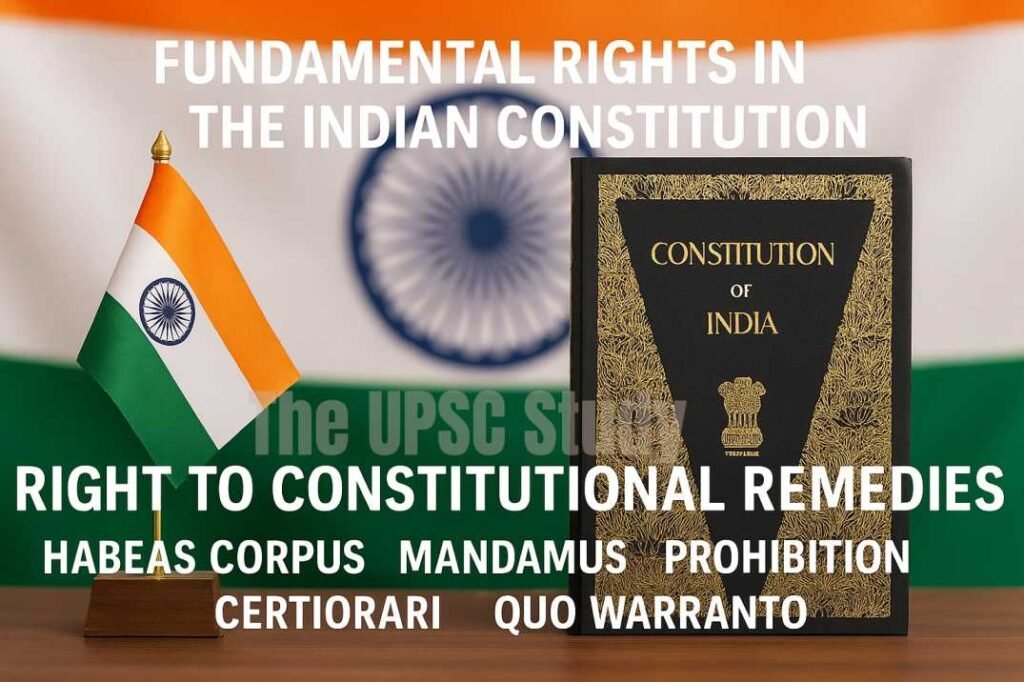
- Article 32 (2)-Power of the Supreme Court to Issue Writs: The Supreme Court shall have the power to issue directions, orders, or writs, including writs in the nature of Habeas Corpus, Mandamus, Prohibition, Quo-Warranto, and Certiorari, whichever may be appropriate for the enforcement of any of the rights conferred by this Part. The Constitution places a duty on the Court to entertain such a petition and provide remedial measures.
- Article 32 (3)- Parliament’s Power to Empower Other Courts: Without prejudice to the Supreme Court’s powers under clauses (1) and (2), Parliament may by law empower any other court to exercise all or any of the powers exercisable by the Supreme Court under (2) within the local limits of its jurisdiction.
- Article 32 (4)- Suspension of Article 32: The right guaranteed by this article shall not be suspended except as otherwise provided for by this Constitution (i.e., by the President during a National Emergency).
Importance of Article 32
The declaration of fundamental rights alone is not sufficient; their enforcement is essential. Article 32 provides the institutional mechanism enabling individuals to seek remedies for violation of the Fundamental rights in Indian Constitution.
Dr. B.R. Ambedkar described Article 32 as:
“The very heart and soul of the Constitution.”
He emphasized that without this provision, the Constitution would be ineffective. The Supreme Court has repeatedly held that Article 32 is a part of the basic structure of the Constitution and therefore cannot be amended, abridged, or removed under Article 368.
The Supreme Court is the Guarantor of fundamental rights. The aggrieved person can directly go to Supreme Courtwithout needing to exhaust other legal remedies. In the event of infringement of any of the fundamental rights of an individual, the constitution places a duty on the Supreme Court to engage the petition of an aggrieved individual and provide remedial measures for him.
The Prerogative Writs: Enforcement Tools of the Fundamental Rights in Indian Constitution
Writs are judicial orders issued by the Supreme Court and High Courts to safeguard the Fundamental rights in Indian Constitution. Borrowed from English law—where they were known as prerogative writs and issued under the royal authority—they now function as essential constitutional tools to protect citizens’ liberties.
Under Article 32, the Supreme Court issues writs exclusively for the enforcement of fundamental rights, making it the “protector and guarantor” of the Fundamental rights in Indian Constitution. In contrast, Article 226 empowers High Courts to issue writs not only for enforcing fundamental rights but also for addressing any legal wrong or injury. Therefore, High Courts possess a wider writ jurisdiction than the Supreme Court. Additionally, Article 32 imposes a constitutional duty on the Supreme Court to issue writs, whereas Article 226 imposes no such duty on High Courts.
The Constitution recognizes five types of writs:
1. Habeas Corpus – “To Have the Body Of”
This writ compels the detaining authority to produce a detained person before the court to examine the legality of detention. It protects individuals from unlawful or arbitrary imprisonment.
- It can be issued against the state, private individuals, or institutions.
- A petition may be filed by the detainee or any other person, including a friend or social worker.
- It also applies in preventive detention and in disputes related to child custody.
- The writ is not issued when:
(a) detention is lawful,
(b) proceedings involve contempt of court,
(c) detention occurs outside the court’s jurisdiction.
2. Mandamus – “We Command”
Mandamus is issued to a public authority directing it to perform a legal or statutory duty it has failed to execute. This writ is discretionary.
Mandamus cannot be issued against:
- Private individuals or bodies,
- Non-statutory departmental instructions,
- Discretionary duties,
- Contractual obligations,
- The President, Governors, or Chief Justices.
(fundamental rights in indian constitution)
3. Prohibition – “To Forbid”
Also known as a stay order, this writ is issued by a higher court to a lower court or tribunal, preventing it from exceeding its jurisdiction.
- It applies only while proceedings are ongoing.
- It stops the court from continuing actions outside its legal authority.
- Prohibition is directed only at judicial or quasi-judicial authorities.
Unlike mandamus (which may be issued to administrative bodies), prohibition is limited to judicial functions.
(fundamental rights in indian constitution)
4. Certiorari – “To Be Certified / To Be Informed”
This writ is issued by a higher court to a lower court or tribunal to:
- Transfer a case, or
- Quash an order passed without or beyond jurisdiction.
Conditions for issuing certiorari:
(a) The authority must be judicial or quasi-judicial,
(b) It must have acted without jurisdiction, exceeded authority, or violated natural justice.
Certiorari operates after an order is passed, unlike prohibition, which acts before the conclusion of proceedings.
In 1991, the Supreme Court ruled that certiorari may be issued even against administrative authorities if their actions affect a person’s rights.
It cannot be issued against legislatures or private individuals.
(fundamental rights in indian constitution)
5. Quo Warranto – “By What Authority?”
This writ examines the legality of claims to a public office. Its objective is to prevent unlawful occupation of public posts.
- It applies only to substantive, permanent public offices created by law or the Constitution.
- It does not apply to private or ministerial positions.
- It may be filed by any interested person, not only the aggrieved party.
(fundamental rights in indian constitution)
Article 33: Power of Parliament to Modify Rights for Forces, etc.
Article 33 provides a statutory exception to the Fundamental rights in Indian Constitution. It empowers only the Parliament to restrict or abrogate the Fundamental rights in Indian Constitution as they apply to members of the armed forces, paramilitary forces, police forces, intelligence bureaus, and other similar services. This power is exercised in the interest of discipline in the forces and national security. Accordingly, Parliament has enacted laws such as The Army Act, The Navy Act, The Air Force Act, and The Border Security Forces Act. These laws impose restrictions on rights like the freedom of speech and expression, the right to form unions, and the right to be associated with political parties.
(fundamental rights in indian constitution)
Article 34: Restriction on Rights while Martial Law is in Force
Article 34 empowers the Parliament to enact legislation to indemnify (protect from legal consequences) any government servant or any other person for any act done by them in connection with the maintenance or restoration of order in any area where martial law was in force. Parliament can also validate any sentence passed, punishment inflicted, forfeiture ordered, or other act done under martial law in such an area.
Martial Law Defined
Martial Law is imposed when conditions of extreme disorder (such as insurrection, war, rebellion, or riots) arise, making the civil authorities, even with military aid, unable to restore control. Martial law involves the suppression of the civil authority by military authority, with the sole object of restoring order as quickly as possible so the civil authority can resume charge. Although Parliament can later ratify actions under martial law, the military commander should, as far as practicable, obtain the approval of the Central Government before imposition. Martial Law is a situation that is different from the proclamation of a National Emergency under Article 352(1).
(fundamental rights in indian constitution)
Article 35: Legislation to Give Effect to Fundamental Rights
rticle 35 grants exclusive power to Parliament to make laws for giving effect to certain provisions relating to the Fundamental rights in Indian Constitution.
This helps ensure uniform application of key rights across India.
Parliament is empowered to legislate on matters connected to:
- Specific provisions under Articles 16, 32, 33, and 34,
- Prescribing punishments for acts declared as offenses under this Part of the Constitution.
An example of legislation enacted under Article 35 is:
The Protection of Civil Rights Act, 1955, which enforces provisions related to the abolition of untouchability.
(fundamental rights in indian constitution)
Conclusion
The Fundamental Rights in Indian Constitution, enshrined in Part III (Articles 12-35), serve as the foundational bedrock for democratic governance. They guarantee indispensable civil liberties, ensuring justice, equality, and dignity for every citizen. Though not absolute, these rights are protected by the judiciary, notably through the powerful remedy of Article 32, which Dr. B.R. Ambedkar called the ‘soul’ of the Constitution. Through landmark cases like Kesavananda Bharati and the expansion of Article 21, the Supreme Court has made the Fundamental Rights in Indian Constitution dynamic, ensuring they remain the ultimate constitutional bulwark against arbitrary state action, essential for individual development and societal progress.