
A Hopeful Nation: Fundamental Rights in Indian Constitution Safeguarding Children and Honouring Every Faith
Table of Contents
(fundamental rights in indian constitution)

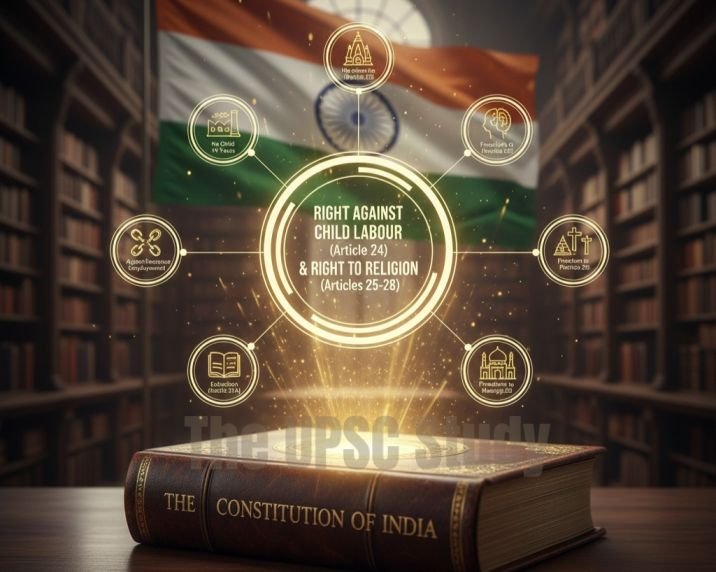
Article 24 – Prohibition of Employment of Children in Factories and Hazardous Work
Article 24, a crucial safeguard under the Fundamental rights in Indian Constitution, explicitly states that no child below the age of fourteen shall be employed in any factory, mine, or in any other hazardous occupation. This Article forms the constitutional foundation of India’s child labour laws and reinforces the commitment to protect children from exploitation.
The Supreme Court has affirmed that children must not be engaged in factory, mines or any hazardous industries and that the State should take positive measures to promote their welfare and improve their quality of life.
Evolution of Statutory Protection
The statutory protection of child workers in India dates back to the Factories Act of 1881 and subsequent legislation, which banned child employment in factories with varying age limits. Globally, the International Labour Organization (ILO) adopted a convention in 1973 fixing the minimum age for employment in certain occupations.
In India, the Mines Act of 1952 already prohibited the employment of children below 18 years of age in a mine. The Employment Children Act of 1938 was later repealed by the passage of the Child Labour (Prohibition and Regulation) Act, 1986.
Definitions and Key Amendments
- Initial Definitions (1986 Act): A child was defined as a person who had not completed 15 years of age. An adolescent was defined as one who had completed 15 but not 18 years of age.
- 2016 Amendment (Child and Adolescent Labour Act): The 1986 Act was amended in 2016 to align with the Right to Free and Compulsory Education Act, 2009.
- It now bans the employment of children aged up to 14 in all occupations.
- Exception: This ban is not violated where the child helps his family after school hours or for their development, provided it is outside school hours.
- An adolescent is defined as a person between 14 and 18 years of age. The amendment prohibits the employment of adolescents in hazardous occupations.
Exceptions and Safeguards
A child helping in household activities outside school hours or contributing to child development is not considered a violation of Article 24. For child artists working in performing arts (movies, pictures, stage performance), they must be accompanied by either parent and require a consent letter from the school head.
Article 24 remains a fundamental pillar in securing the dignity and future of children, essential to the Fundamental rights in Indian Constitution.
(fundamental rights in indian constitution)
Right to freedom of religion (Article 25 to 28)
This right under the Fundamental Rights in Indian Constitution, directs state to makes provisions for an individual and a community to have freedom of their conscience and faith without any discrimination and prohibition.
India by constitution is a secular nation yet unlike the western philosophy of secularism, known as Laïcité, which believes in separation of affairs of the state and religion (religion as private matter), Indian secularism believes in the equidistance from all religions yet equal-protection of all religions by the state, and make rules and regulations to check on inter-religion and intra-religion dominance, based on caste, gender, place, status, regressive dogmas etc. The state can lay provisions for upliftment of religious minority (that will be explained in article 29 & 30).
(fundamental rights in indian constitution)
Article 25: Freedom of Conscience and the Right to Profess, Practice, and Propagate Religion
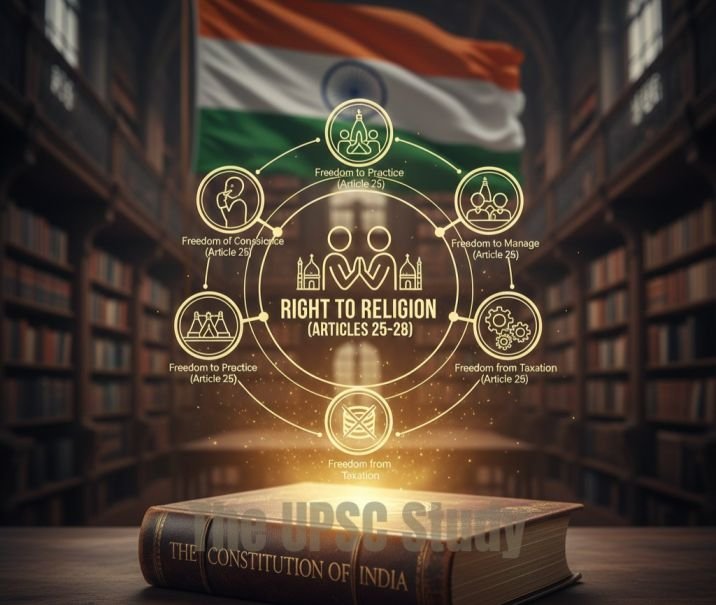
Article 25(1): Individual Rights and Limitations: Article 25(1) guarantees that, subject to public order, morality, health, and other provisions of Part III, all persons have the freedom of conscience and the right to freely profess, practice, and propagate their religion.
Article 25(1) protects several personal religious freedoms:
- Freedom of Conscience: The inner freedom to mould one’s relation with God or creatures.
- Right to Profess: The right to declare one’s religious beliefs and faith openly.
- Right to Practice: The performance of religious worship, rituals, and ceremonies.
- Right to Propagate: The transmission of one’s religious beliefs to others. This includes voluntary conversion of one’s own faith but does not include a right to convert another person to one’s religion by force or allurement (Rev. Stanislaus v. State of MP, 1977).
Article 25(2): State’s Power to Regulate and Reform: This clause ensures that the State’s existing laws or new laws can perform two functions without being affected by Article 25(1):
- (a) Secular Regulation: Regulating or restricting any economic, financial, political, or other secular activity associated with religious practice (e.g., regulation of temple or church finances).
- (b) Social Reform: Providing for social welfare and reform or the throwing open of Hindu religious institutions of a public character to all classes and sections of Hindus (including Sikhs, Jains, and Buddhists). This balances religious freedom with the need for social progress, allowing the State to combat social evils like polygamy or untouchability.
Meaning of Religion and Religious Denomination
The Constitution does not explicitly define “religion” or “religious denomination.” The Supreme Court notes that religion is rooted in faith and belief, encompassing spiritual doctrine, rituals, ceremonies, and practices integral to the faith.
A religious denomination is a sect or group with a common faith, common organization, and a distinctive name.
Restrictions Under Article 25 (2)
Although Article 25 guarantees an individual right, it is not absolute. The State may impose reasonable restrictions on grounds of:
1. Public Order, Morality, and Health
- For example, one cannot offer prayers on a busy highway or use a loudspeaker in a way that offends others. The right under Article 25 does not extend to using public roads and footpaths for religious purposes, as affirmed by the Karnataka High Court guidelines.
2. Regulating Secular or Economic Activities Associated with Religion
- Such as temple administration, church finances, or mosque management.
3. Social Reform
- The State may legislate against harmful or discriminatory practices like Sati, Devadasi, polygamy, caste discrimination, etc.
- Article 25(2)(b) specifically allows the State to open Hindu public temples to all sections of the Hindu community, a measure aimed at removing caste-based exclusion and advancing equality, a core element of the Fundamental rights in Indian Constitution.
Doctrine of Essentiality or Doctrine of Essential Religious Practices(ERP)
Essential Religious Practice (ERP), also known as doctrine of essentiality, are such practices in a practice of a religion in the absence of which religion stands diluted. There have been a number of writs in courts for the violation of ERP by the state, especially the Shirur math case (1954) that established the essentiality of religious practices as freedom of religious practice.
For instance, The wearing and carrying of Kirpans shall be deemed to be included in the profession of the Sikh religion considering it as Essential Religious Practice (ERP).
Landmark Cases on Religious Freedom
- Rev. Stanislaus v. State of Madhya Pradesh (1977): The Supreme Court upheld anti-conversion laws, ruling that “propagation” under Article 25 does not include the right to convert another person, especially through force, fraud, or inducement.
- Karnataka High Court Ruling on Use of Public Roads (2024–25): The Court clarified that Article 25 does not grant a right to use public roads or footpaths for religious activities.
Key directives included:- Authorities must not grant permissions mechanically.
- Mandatory inspection and traffic police reports are required.
- Temporary structures should not block traffic or footpaths.
- No digging of roads/footpaths for religious installations.
- Permissions must be displayed at the site; otherwise, structures are treated as illegal.
Cases on Essential Religious Practices (ERP)
- Shirur math case (Hindu Religious Endowments, Madras v. Shri Lakshmindar Tirtha Swamiar of Shri Shirur Mutt-1954): the supreme court held that the State can regulate the economic and commercial activities of religious institutions but cannot interfere with their essential religious practices, the term “religion” will cover all rituals and practices “integral” to a religion, here the doctrine of essentiality was brought into existence. This ruling affirmed the autonomy of religious denominations to manage their own affairs as guaranteed by Article 25, 26 of the Constitution.
- Dr. M. Ismail Faruqui v Union of India (1994): The court held that while offering of prayers is an essential practice, the offering of such prayers in the mosque is not, unless the place has a particular religious significance in itself. However, it refused to consider the question of whether the freedom of religion protects only practices of particular significance, and not all religious practices.
- Nikhil Soni v. Union of India 2015: The Rajasthan High Court held the practice of Santhara (Sallekhana), fasting unto death to attain ‘moksha’, impermissible under Article 21 of the Constitution (protection of life) and it could not be included as an essential religious practice under Article 25 of the Constitution.
- Church of God (Full Gospel) in India v. K.K.R. Majestic Colony Welfare Association (2000): The Supreme court ruled that loud speakers are not essential religious practice. Right to religion is not absolute, the right to freedom of conscience and to profess, practice, and propagate religion is subject to public order, morality, and health, as well as other citizens’ rights. The Court observed that no religion prescribes or preaches that prayers must be performed using voice amplifiers or by beating drums in a manner that disturbs others. The Court mandated the strict implementation of the Noise Pollution (Regulation and Control) Rules, 2000, and other relevant laws, ruling that authorities have the power to regulate the use of loudspeakers and sound amplifiers.
This prohibition of loudspeaker was again iterated by the Bombay High Court in 2025, for playing loudspeaker in Masjid for calling Azaan (the Islamic call to prayer), the court stated that using loudspeakers for religious purposes like azaan is not a fundamental right and that authorities must take action to enforce noise pollution laws, including the 10 PM to 6 AM ban on loudspeakers in residential areas. - Sabarimala case (2018): Supreme Court allowed women to enter in Sabarimala temple in Kerala. Right to practice is applicable to every individual of a faith, and prohibition of women is the violation of Article 14, 15, 21 and 25.
- Hijab Ban case (Reshma v. State of Karnataka-2022): In 2022, the Karnataka high court had dismissed the petitions filed by a section of Muslim students in Karnataka seeking permission to wear the hijab inside classrooms, ruling it is not a part of the essential religious practice in Islamic faith, banned the wearing of hijabs and other religious clothing in government colleges, citing the need for equality, integrity, and public order. On the same matter, a writ was filed in the Supreme Court in 2022 which had a split view of the matter and temporary validating the ban on hijab in government institutes until a further conclusion arrives in the matter.
(fundamental rights in indian constitution)
Article 26: Freedom to Manage Religious Affairs
Article 26 guarantees collective rights to religious groups, making it distinct from Article 25 which focusses on individual rights. This article ensures that every religious denomination or any section thereof shall have the right to manage its affairs, reinforcing the Fundamental rights in Indian Constitution.
The article provides an institutional right to a religious denomination or entity, allowing it to manage institutions, properties, and other affairs deemed essential to its faith, provided these actions align with the provisions of law.
Article 26 guarantees that, subject to public order, morality and health, every religious denomination or any section thereof has the following rights:
(a) To establish and maintain institutions for religious and charitable purposes.
(b) To manage its own affairs in matters of religion.
(c) To own and acquire movable and immovable property.
(d) To administer such property in accordance with the law.
This Article protects the autonomy of religious denominations and institutions, enabling them to maintain their religious practices, properties, and internal affairs, as long as these operate within the framework of the law, as this right conform to public rorder, morality of the society and people and health of the people, an important distinction within the Fundamental rights in Indian Constitution.
Legal Developments and Judicial Interpretations
- Ayodhya Case (M. Siddiq (D) v. Mahant Suresh Das, 2019): The Supreme Court held that a Hindu deity or idol is a “legal person”, capable of owning property. This concept is known as shebaitship, where the deity is the juristic owner while the shebait (manager) administers the property on its behalf. The Court clarified that while “God” or the “Supreme Being” is not a legal person, a deity in Hinduism is recognized as one.
- Places of Worship Act, 1991: The Places of Worship (Special Provisions) Act, 1991 is a central law that:
- Prohibits the conversion of the religious character of any place of worship,
- Mandates that the religious character of a site must remain as it existed on 15 August 1947,
- Seeks to prevent communal disputes and maintain harmony.
- The Act includes two exceptions:
- The Babri Masjid–Ram Janmabhoomi (Ayodhya) dispute, and
- Ancient monuments protected under other laws.
This legislation complements the spirit of Article 26 and reinforces the broader commitment of the Fundamental rights in Indian Constitution to ensure religious freedom alongside social order and peace.
(fundamental rights in indian constitution)
Article 27: Freedom from Payment of Taxes for Promotion of a Particular Religion
Article 27 provides that no person shall be compelled to pay taxes whose proceeds are specifically used for the promotion or maintenance of any particular religion or religious denomination. This ensures that the State does not financially support one religion over another, maintaining neutrality as mandated under the Fundamental rights in Indian Constitution.
The Article further implies that public funds cannot be used by the State to promote or maintain a religion. However, Article 27 does not prohibit the State from charging fees when such fees are intended to cover the cost of secular services provided to religious pilgrims such as safety, sanitation, or administrative arrangements. These fees are regulatory in nature and not for promoting religious activity. Thus, tax is prohibited and a fee is permitted.
Judicial Interpretations and Key Cases
- Prafull Goradia v. Union of India (2011): In this case, the Supreme Court upheld the constitutional validity of the Haj subsidy, holding that the amount spent was relatively small and did not constitute diversion of tax revenue to promote a particular religion. Therefore, the subsidy did not violate Article 27.
- Sri Jagannath Ramanuj Das v. State of Orissa (1954): Mahants of the Jagannath institutions challenged the Orissa Hindu Religious Endowments Act, 1939 (amended in 1952), arguing that the State:
- Exercised excessive control over temple administration,
- Imposed levies in the name of fees for regulating religious institutions, and
- Charged for maintenance of public facilities such as the Pushkarini water tank used by the general public.
- They claimed these provisions violated Articles 26 and 27, which protect institutional religious freedom and prohibit taxation for religious promotion.
- The Supreme Court ruled:
- The State can regulate secular administration of religious endowments.
- The supervisory fee was valid because it covered regulatory expenses.
- However, the fee for maintaining the public water tank was essentially a tax, not a legitimate regulatory fee, and thus invalid under Article 27.
- Therefore, the Act was largely upheld, except for provisions granting excessive State control and imposing unjustified levies.
(fundamental rights in indian constitution)
Article 28 – Freedom Concerning Religious Instruction in Educational Institutions
Article 28 (which operates alongside Article 29 in safeguarding cultural and educational freedoms under the Fundamental rights in Indian Constitution) provides protections regarding religious instruction and worship in educational institutions.
The Article classifies educational institutions based on their maintenance and administration:
- Article 28(1) – Wholly State-Maintained Institutions: No religious instruction shall be provided in any educational institution wholly maintained out of State funds.
- Article 28(2) – State-Administered but Trust-Established Institutions: The prohibition in Clause (1) shall not apply to an institution that is administered by the State but was established under any endowment or trust which requires that religious instruction shall be imparted. Here, religious instruction is permitted.
- Article 28(3) – State-Recognized or Aided Institutions: No person attending an educational institution recognised by the State or receiving aid out of State funds shall be required to take part in any religious instruction or attend any religious worship conducted there, unless such person (or their guardian, if minor) has given their consent thereto. The State has a discretionary power in these cases.
Judicial Interpretation and Examples
- Distinction between Study and Instruction (DAV College vs. State of Punjab, 1971): The Supreme Court clarified that Article 28 does not prohibit the study of religion as part of a curriculum (e.g., studying the life of Guru Nanak in B.A. Philosophy). It only prohibits the imparting of religious instruction (dogmatic teaching or worship).
- BHU Act, 1915: The Benaras Hindu University (BHU), established as a Hindu institution, became a central university after the 1951 amendment. Subsequent amendments (last in 1969) gave it a secular image.
- AMU Act, 1920: The Aligarh Muslim University (AMU), originally a minority religious university, was amended in 1951 to become a public university by repealing sections on Islamic teachings. However, the 1981 amendment declared AMU a minority institution under Article 30. In 2024, the Supreme Court ruled that AMU is entitled to minority status, overturning a 2005 verdict of Allahabad that invalidated the 1981 amendment.
These provisions collectively define the permissible limits of religious activity in State-funded and aided education, securing the religious freedom aspect of the Fundamental rights in Indian Constitution.
(fundamental rights in indian constitution)
(fundamental rights in indian constitution)