
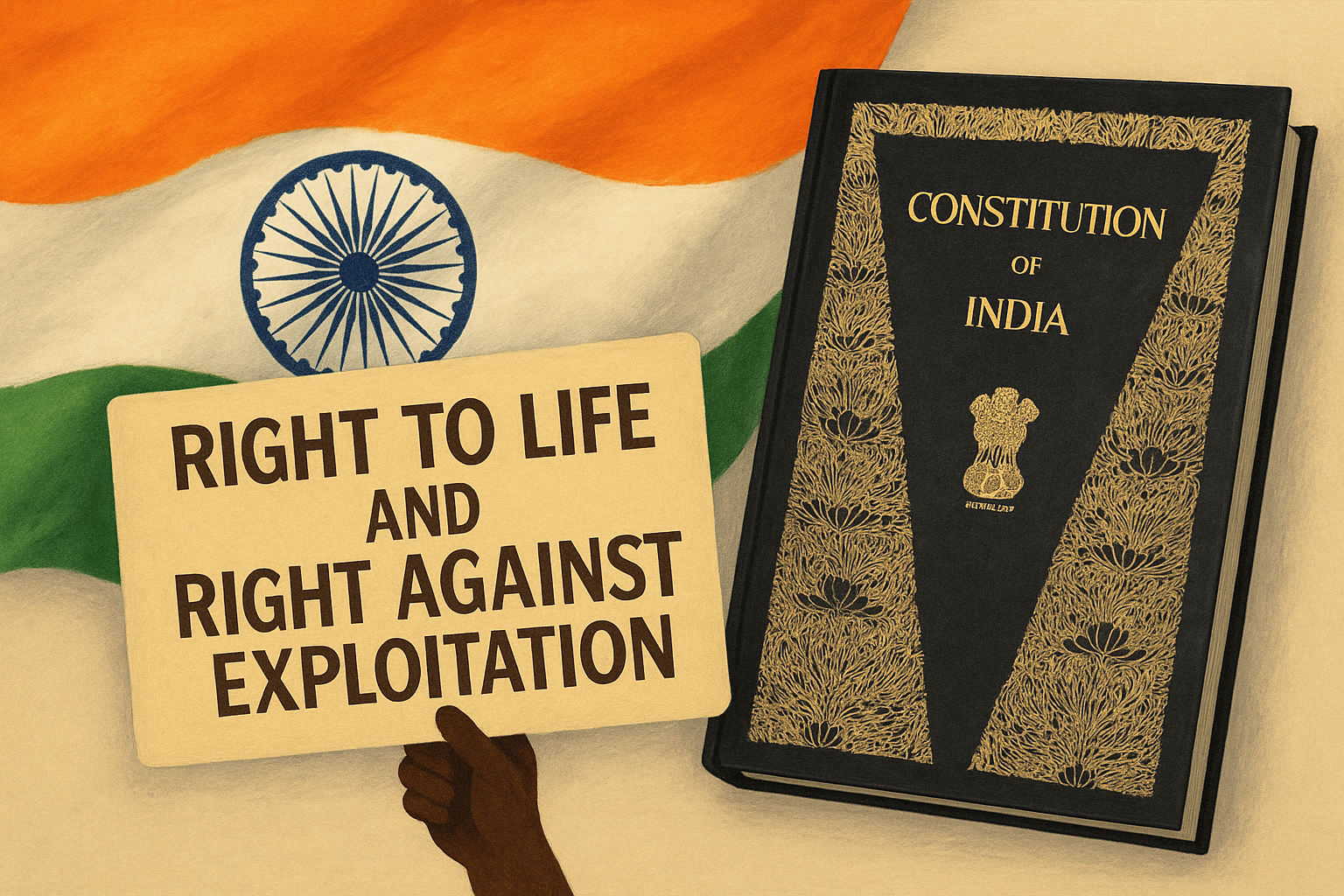
Defending Dignity: The fundamental rights in Indian Constitution That Protect Life and End Exploitation
Table of Contents
(fundamental rights in indian constitution)
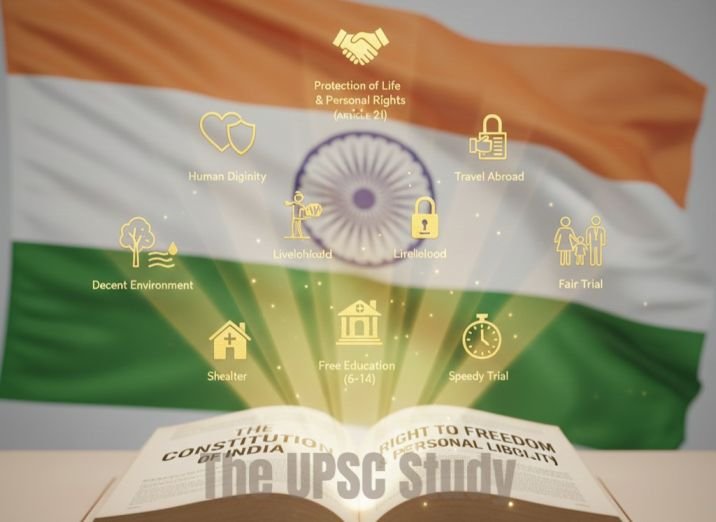
Article 21: Protection of life and personal liberty.
Article 21, one of the most expansive Fundamental rights in Indian Constitution, states that No person shall be deprived of life or personal liberty except according to procedure established by law. It ensures that any action restricting personal freedom must follow a legal, fair, and non-arbitrary process.
During the Constituent Assembly debates, the framers deliberately chose the phrase “procedure established by law” instead of “due process of law,” as they feared the latter would allow unelected judges to overturn legislation passed by an elected Parliament.
Early Interpretation:
In the A.K. Gopalan case, the Supreme Court adopted a narrow interpretation of Article 21.
- The Court validated the Preventive Detention Act, 1950, and held that the protection under Article 21 was available only against arbitrary executive action and not from arbitrary legislative action.
- The Court stated that India need not apply the American concept of “due process of law,” and only the existence of a validly enacted procedure was required.
The Overruling and Expansion:
The Supreme Court overruled its Gopalan judgment in the Maneka Gandhi case. This ruling fundamentally changed the scope of Article 21:
- The Court held that the life and personal liberty of a person could only be deprived by a law if the procedure prescribed by that law is reasonable, just, and fair, and not arbitrary.
- This effectively introduced the principle of due process of law into Fundamental rights in Indian Constitution through Article 21.
- The Court clarified that Article 21, Article 19, and Article 14 are interconnected (the golden triangle of the fundamental rights in Indian constitution), and the reasonableness test of article 19 must apply to Article 21 as well.
- Such a violation can be challenged under Articles 32 and 226, allowing courts to review and question the reasonableness of the law itself under Article 13.
Procedure Established by Law vs. Due Process of Law
Procedure established by Law: Taken from British doctrine, it states that the law passed by the legislature if followed a proper procedure, is valid. The Court only checks whether the law or provision itself exists and was properly passed by the legislature, regardless the question of its fairness and justness. This approach prioritises legislative supremacy.
Due process of Law: Taken from the US judiciary system, it states that a law should not only follow a proper procedure of legislature but also be fair, just and reasonable. Neither the legislation nor the implementation of the law should be arbitrary. The court can examine both the procedure and fairness of the law in protecting the rights of the people. It favours judiciary’s capacity.
Due process of law includes such constitutional requirements as adequate notice, assistance of counsel, and the rights to remain silent, to a speedy and public trial, to an impartial jury, and to confront and secure witnesses.
Procedural due process ensures if the law is clearly written and whether it grants the
- Right to fair and public trial.
- Right to be present at the trial.
- Right to an impartial jury.
- Right to self-defense, etc.
Rights Recognised Under Article 21
Through various judgments, the Supreme Court has interpreted “life and personal liberty” broadly, declaring the following rights as intrinsic components of Article 21:
- Right to live with human dignity.
- Right to a decent environment, including pollution-free water and air, and protection against hazardous industries.
- Right to livelihood.
- Right to privacy.
- Right to shelter and health.
- Right to free education up to 14 years of age (now guaranteed by Article 21-A).
- Right to free legal aid.
- Right against solitary confinement and inhuman treatment.
- Right to a speedy trial and a fair trial.
- Right against handcuffing and against public hanging.
- Right against delayed execution.
- Right to travel abroad.
- Right against bonded labour.
- Right against custodial harassment.
- Right to emergency medical aid and timely medical treatment in government hospitals.
- Right not to be driven out of a state.
- Right of a prisoner to have necessities of life and the right of women to be treated with decency and dignity.
- Right to hearing and the Right to information.
- Right to reputation.
- Right of appeal from a judgment of conviction.
- Right of social security and protection of the family.
- Right to social and economic justice and empowerment.
- Right against bar fetters and the Right to an appropriate life-insurance policy.
- Right to sleep.
- Right to freedom from noise pollution.
- Right to electricity.
- Right to Internet.
The expansive interpretation of this article underscores its status as a vital component of the Fundamental rights in Indian Constitution.
Landmark Cases Related to the Right to Life under Article 21
Several Supreme Court judgments have expanded the meaning and scope of the right to life under Article 21, making it one of the most dynamic Fundamental rights in Indian Constitution. Below are major cases that shaped this interpretation:
F. C. Mullin vs. U.T. of Delhi (1981): The Court held that any law restricting Article 21 must be fair, reasonable, and just, as the right to life and personal liberty is non-alienable.
Olga Tellis vs. Bombay Municipal Corporation (BMC) (1986): Recognised the Right to Livelihood as an integral part of Article 21, stating that depriving someone of livelihood is equivalent to depriving them of life.
Hussainara Khatun vs. State of Bihar (1979): The Court declared that the Right to free legal aid is a component of the right to life. This judicial recognition complemented the inclusion of free legal aid as a Directive Principle under Article 39A by the 42nd Amendment, 1976, leading to the establishment of the National Legal Services Authority (NALSA).
Vishakha vs. State of Rajasthan (1997): The Court recognized the Right against sexual harassment at the workplace as part of the right to life. These Vishakha Guidelines laid down rules for prevention (POSH), and were later superseded by the Sexual Harassment of Women at Workplace (Prevention, Prohibition and Redressal) Act, 2013.
K. S. Puttaswamy vs. Union of India (2017): The Right to privacy was declared a Fundamental Right under Article 21. This right can only be restricted on three grounds: it must have a legislative mandate, it must serve a legitimate state purpose and reason, and the restriction must be the least intrusive among other possible provisions under Article 21.
This ruling significantly strengthened privacy as one of the essential Fundamental rights in Indian Constitution, and have been brought in many cases in such as- Digital Protection and data protection act (2023), right to forgotten, Vinit Kumar case (2019)- against telephone tapping, Adhaar review case (2018) and as recent as protest against Sachar Saathi App, by DoT.
Shayara Banu vs. Union of India (2017): The practice of triple talaq under Talaq-e-Biddat was declared unconstitutional for infringing upon Articles 14 (Equality) and 21 (Right to Life).
Navtej Singh Johar vs. Union of India (2018): Recognised consensual same-sex relations as part of the Right to Personal Liberty.
The Supreme Court decriminalised the relevant portion of Section 377 IPC, citing violations of Articles 14, 15, 19, and 21, while retaining provisions related to paedophilia, non-consensual acts, and bestiality.
Zorawar Singh Mundy vs. Union of India (2021): The Court recognized the “Right to be forgotten” as a Fundamental Right under Article 21. This right, concerning the removal of personal and private information from digital documents, social media, and non-governmental accounts, forms the basis of the upcoming Digital Personal Data Protection (DPDP) Rule, 2025, which will replace the IT Act, 2000. It enables clients or data principals to seek the removal of their personal data from data fiduciaries (data collectors).
Note: Articles 20 and 21 of the Fundamental Rights in Indian Constitution cannot be suspended during an emergency. Article 20 provides protection in respect of conviction for offences, and Article 21 guarantees the right to life and personal liberty. This protection was made a permanent feature of the constitution through the 44th Amendment Act of 1978.
(fundamental rights in indian constitution)
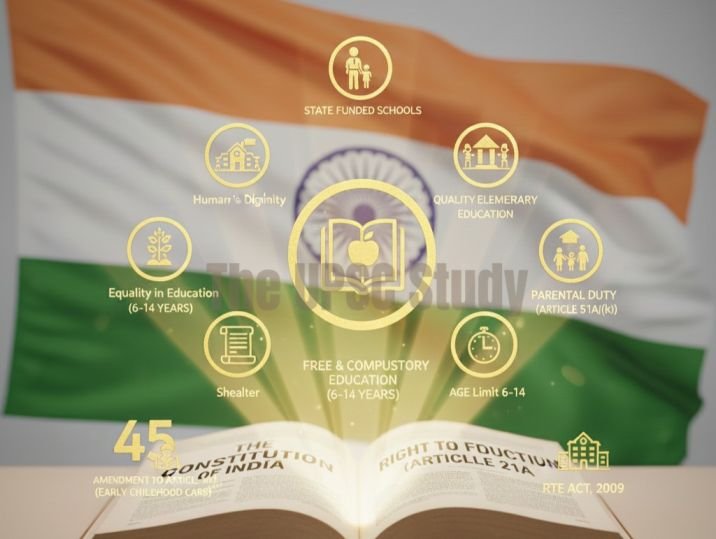
Article 21A: Right to Education
Article 21A, introduced as part of the Fundamental rights in Indian Constitution, states that “the State shall provide free and compulsory education to all children aged 6 to 14 years in such manner as the State may, by law, determine.” This provision makes only elementary education a fundamental right, excluding higher or professional education. It was inserted by the 86th Constitutional Amendment Act, 2002, marking a historic step toward achieving universal education in India and strengthening the scope of Fundamental rights in Indian Constitution.
Consequential Changes
The 86th Amendment necessitated two important corresponding changes:
- Change in DPSP (Article 45): Before this amendment, Article 45 in the Directive Principles of State Policy (DPSP) required the State to provide free education to children aged 6 to 14. After the 86th Amendment, Article 45 was modified to focus on early childhood care and education for all children up to the age of six years, shifting its earlier mandate.
- New Fundamental Duty (Article 51A(k)): The amendment also added a new feature (sub clause- k) in the Fundamental Duty under Article 51A, stating that every citizen must provide educational opportunities to their child or ward between the ages of 6 and 14 years. The Article 51A was added through 42nd Constitutional Amendment Act of 1976.
Implementation
To give effect to this right, Parliament passed the Right of Children to Free and Compulsory Education (RTE) Act, 2009. This Act ensures that every child has a right to be provided full-time elementary education of satisfactory and equitable quality in a formal school that meets certain essential norms and standards. This reinforces the comprehensive nature of the Fundamental rights in Indian Constitution.
(fundamental rights in indian constitution)
Article 22: Protection against arrest and detention in certain cases
Article 22 guarantees safeguards against arbitrary arrest and detention, distinguishing between punitive (after commission of an offense) and preventive (to forestall future offenses) detention. This article is a critical component of the Fundamental rights in Indian Constitution.
Punitive Detention Safeguards (Article 22(1) to 22(3))
Article 22(1): Right to be Informed and Legal Counsel: No arrested person shall be detained in custody without being informed, as soon as may be, of the grounds for such arrest. The person also has the right to consult with and be defended by a legal practitioner of their choice.
Article 22(2): Production before Magistrate: Every arrested and detained person must be produced before the nearest judicial magistrate within a period of twenty-four hours of the arrest. This period excludes the time necessary for the journey. No person shall be detained beyond this period without the magistrate’s authority. (A judicial magistrate issues warrants, police custody (max. 14 days), and bail; judicial custody is issued by sessions courts when the trial begins.)
Article 22(3): Exceptions: The safeguards in Article 22(1) and (2) do not apply to an enemy alien (a foreigner from an enemy nation) or a person detained under preventive detention laws.
Preventive Detention Provisions (Article 22(4) to 22(7))
Article 22(4): Time Limit and Advisory Board: No law providing for preventive detention shall authorize detention for a period longer than three months, unless an Advisory Board allows further extension on sufficient grounds.
- The Advisory Board must be headed by a person qualified to be, or who is or has been, a Judge of a High Court.
- The Board cannot extend detention beyond the duration prescribed by Parliament under Article 22(7). The detainee is held in accordance with Parliamentary law.
Article 22(5) and 22(6): Communication and Representation: The detainee must be informed of the reasons for detention as soon as possible, to avail the earliest opportunity of making a representation against the order. However, the detaining authority can withhold such information if its disclosure is deemed to be against the public interest.
Article 22(7): Parliament’s Power: This clause empowers Parliament to supersede the Advisory Board’s authority by providing, through legislative power, that the Board’s opinion is not necessary to extend detention beyond three months in certain classes of cases. Parliament can also provide the maximum period of preventive detention and prescribe the procedure to be followed by the Advisory Board.
Punitive vs. Preventive Detention
Punitive Detention
Punitive detention refers to punishing a person for an offence already committed, following a criminal trial and conviction.
- Governed by criminal laws like the criminal procedure codes (CrPC/BNSS) and penal laws (IPC/BNS).
- A judicial magistrate issues warrants, bail, and orders for custody.
- It is reactive, addressing crimes already committed.
Preventive Detention
Preventive detention aims to prevent a person from committing a future offence.
- Allows detention without a trial for a temporary period.
- Executive authorities such as the District Magistrate or Sub-Divisional Magistrate can issue detention orders.
- It is proactive, justified only when the person’s actions threaten public order, security of the State, or violate the golden triangle of Articles 14, 19, and 21.
Major Preventive Detention Laws
Parliament has enacted several laws under this framework:
- Preventive Detention Act, 1950 (repealed in 1969)
- Conservation of Foreign Exchange and Prevention of Smuggling Activities Act (COFE-POSA), 1974.
- National Security Act (NSA), 1980.
- Prevention of Black-marketing and Maintenance of Supplies of Essential Commodities Act (PBMSECA), 1980.
- Prevention of Illicit Traffic in Narcotic Drugs and Psychotropic Substances Act (PITNDPSA), 1988.
Article 22 is a critical balancing mechanism within the Fundamental rights in Indian Constitution, ensuring state security while protecting individual liberty.
(fundamental rights in indian constitution)
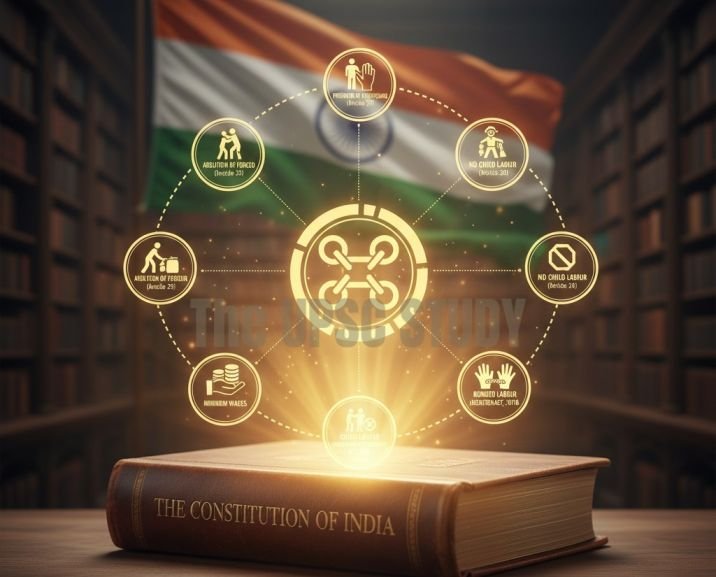
Right against exploitation (Article 23 & 24)
Right against exploitation part of the Fundamental Rights in Indian Constitution commands the state to prohibit certain exploitations by imposing law.
(fundamental rights in indian constitution)
Article 23: Prohibition of traffic in human beings and forced labour.
Article 23, a crucial safeguard under the Fundamental rights in Indian Constitution, prohibits human trafficking, begar, and all forms of forced labour. It ensures that no individual is compelled to work against their will and treats any violation as a punishable offence.
Article 23(1): Prohibition: Traffic in human beings, begar, and other similar forms of forced labour are prohibited. Any contravention of this provision is deemed an offence punishable in accordance with law.
- Traffic in human beings includes buying and selling of men, women, and children, and extends to practices such as prostitution, devadasi system, and slavery.
- Begar refers to involuntary labour without payment.
- Forced labour includes compelling a person to work even if remuneration is paid; if payment is below minimum wage, it also qualifies as forced labour.
- Bonded labour includes forms such as debt bondage, loans, and advances where a person is compelled to work in exchange for monetary or physical assistance.
Article 23(2): Exception: The State can impose compulsory service for public purposes. In imposing such service, however, the State shall not make any discrimination based only on the grounds of religion, race, caste, class, or any of them.
Legislative Action Against Bonded Labour
- Bonded Labour System (Abolition) Act, 1976: This Act extends to the whole of India but is implemented by respective state governments.
- It provides for an institutional mechanism at the district level through Vigilance Committees.
- These committees advise the District Magistrate (DM) to ensure proper implementation of the Act’s provisions.
- State Governments/UTs may confer the powers of a Judicial Magistrate (first or second class) for the trial of offenses under this Act on an Executive Magistrate.
- Central Sector Scheme for Rehabilitation of Bonded Labourers (2016): Under this scheme,
- Financial assistance of up to ₹3 lakh is provided to released bonded labourers.
- Additional non-cash support for livelihood rehabilitation is also offered.
Global Trend: Human Trafficking (UNODC 2018): The 2018 Global Report on Trafficking in Persons by the United Nations Office on Drugs and Crime (UNODC) showed that human trafficking is on the rise, with sexual exploitation being the main driver. This underscores the contemporary relevance of the Fundamental rights in Indian Constitution.
Key Findings on Victims and Factors:
- Detection and Reporting: Asia and the Americas have seen the largest increase in victims detected, which may be due to improved reporting methods or a real increase in victims. Although convictions have increased in these regions, the study concludes that large areas of impunity still exist in many Asian and African countries, and conviction rates remain very low. The global trend in reported victims has shown a steady increase since 2010.
- Victims: Women and girls make up most trafficking victims worldwide. Almost three-quarters (73%) are trafficked for sexual exploitation. Thirty-five percent (35%) of women and girls are trafficked for forced labour. Children now account for 30% of those being trafficked, with far more girls detected than boys.
- Factors by Region: Trafficking for sexual exploitation is most prevalent in European countries. In sub-Saharan Africa and the Middle East, forced labour is the main factor.
- Source Region: Victims are trafficked from most South Asian countries, including Bangladesh, India, and Pakistan, and to a limited extent, Nepal and Sri Lanka.
(fundamental rights in indian constitution)