
Your Freedom, Your Voice: Why the Fundamental Rights in Indian Constitution Matter.
Previous blogs 1 and 2 were explained with the provisions in the fundamental rights in Indian constitution till Article 18. In this blog we shall start the
Right to freedom (Article 19 to 22), with the provisions in Article 19, which is one the 3 main articles of fundamental rights in Indian constitution, others being 14 and 21, called Golden triangle of Fundamental rights in Indian Constitution.
(fundamental rights in Indian constitution)
Table of Contents
(fundamental rights in Indian constitution)
2.Right to freedom (Article 19 to 22)
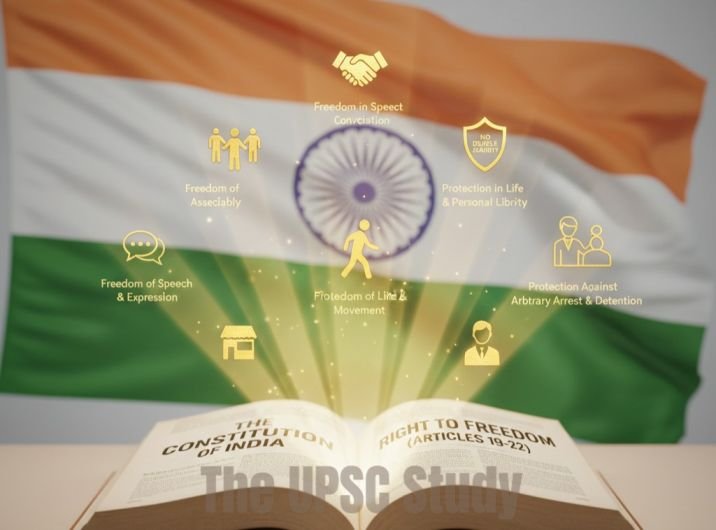
In Fundamental rights in Indian Constitution, Right to Freedom is an essential part. It forms the two arms of the golden triangle of the fundamental rights in Indian Constitution.
(fundamental rights in Indian constitution)
Article 19: Protection of certain rights regarding freedom of speech etc.
All the citizens shall have right:
(a) To freedom of speech and expression
(b) To assemble peacefully and without arms.
(c) To form associations or Unions or co-operative societies. (the co-operative society was added though 97th CAA-2011 along with PART IX-B and Article 43B).
(d) To move freely throughout the territory of India: (unless restricted or limited by the state such as border areas, notified areas like reserved forest and wildlife reserves, Schedule V and VI regions and areas required Inner line permits).
(e) To reside and settle in any part of the territory of India. (unless restricted by state or have special provisions by the parliament).
(f) To acquire immovable property. (Repealed by 44th Amendment Act 1978 along with Article 31)
(g) To provide any profession or to carry on any occupation, trade, or business. (deemed legal and moral by the state).
These six rights under right to freedom in the Fundamental rights in Indian Constitution, apply only against State action, not against private individuals. They are available exclusively to citizens and to shareholders of a company, but not to foreigners or to legal entities such as companies or corporations. No freedom is absolute. Reasonable restrictions may be imposed to maintain a balance between individual liberty and public order. The Supreme Court has clarified that such restrictions are considered reasonable when the limits placed on a person’s rights are not excessive in nature.
(a) Right to Freedom of Speech and Expression- Article 19(1)(a)
This right allows a person to freely express convictions and opinions through speech, writing, printing, pictures, dramatics, cinema, or any other medium. It includes both good and bad speech but excludes hate speech. It also covers access to expressive content created by others.
The Supreme Court has held that this right for freedom of speech under Fundamental rights in Indian Constitution includes:
- The right to propagate one’s own views and those of others.
- Freedom of the press.
- Freedom of commercial advertisements.
- Protection against telephone tapping.
- Right to broadcast and freedom for electronic media.
- Right against bandh or strikes called by political parties.
- The freedom to remain silent.
These freedoms are not absolute. The State may impose reasonable restrictions under Article 19(2).
Reasonable Restrictions (Article 19(2))
Restrictions should not be arbitrary– disproportionate or unjustified, and imposed through legislative procedures. The concept of “reasonable restrictions” (along with expressions public order, friendly relations with foreign states, and incitement to an offence) was added by the 1st Constitutional Amendment Act, 1951.
- Nature of Restriction: Courts determine reasonableness by considering the nature of the restriction and the procedure prescribed by law enforcement.
- Education: Helps promote responsible use of free speech, protects minorities, empowers women, and enhances transparency.
- Awareness: Public authorities, NGOs, and CSOs can spread awareness about free speech.
Need for Free Speech
- Accountability: Media and civil society highlight critical issues and hold the government accountable.
- Active Participation: Strengthens freedom of assembly and enables people to influence public decisions.
- Equality: Allows marginalised communities to voice issues and mobilise support.
- Innovation: Protects artistic and creative expression—academic works, theatre, cartoons, and visual arts.
- Development: Encourages exposure to diverse ideas, fostering independent thinking.
- Foundation: Free speech supports other rights, including a free press and an informed electorate.
Grounds for Restriction
Restrictions can be imposed on the grounds of:
- Sovereignty and integrity of India: Any speech or expression which can be threat to India can be restricted under article 19(2). Added by the 16th Amendment Act, 1963, to impose on on Individuals or groups to curb secessionist movements.
- Security of the state: for the sake of nation security, restriction on activities risking the security of the nation.
- Friendly relations with foreign States: To curb malicious actions, to jeopardize the reputation of the country and to maintain positive relations with other countries in a globalised world.
- Public order, decency, or morality: To prohibit marketing or distribution or advertisement of salacious words or pictures in public places which could lead to social unrest or cause discomfort to a particular society or society at large.
- Contempt of court: To maintain the judiciary’s stature (punishable under Article 129 for Supreme Court and 215 for High Courts).
- Defamation or incitement to an offence: Restricting freedom of individual or group for instigating and provoking to commit an offence or encourage communal violence (added by the 1st CAA, 1951).
Freedom of the Press
The Fundamental rights in Indian Constitution does not grant a separate guarantee for the freedom of the press; it is included within the wider freedom of expression (Article 19(1)(a)). Freedom of the press includes expressing others’ opinions. It enables public access to information and informed debate. It consists of:
(i) Access to information sources.
(ii) Freedom of publication.
(iii) Freedom of circulation.
Limitations: It is subject to the same limitations provided by Article 19(2). Imposing press censorship on publication is a violation of this freedom of speech and expression. Past restrictive laws like the Indian Press (Emergency) Act, 1931 and the Press Objectionable Material Act, 1951 have been repealed. Media is now subject to the Press Council of India regulations. The state can impose reasonable restrictions on the exercise of the freedom of speech and expression on the ground of sovereignty and integrity of India, security of state, friendly relations with foreign states, public order, decency or morality, contempt of court, defamation, an incitement to an offence.
Immunity (Article 361-A): No person is liable to any civil or criminal proceedings in any court for publishing a subsequent true report of the proceedings of Parliament or a Legislative Assembly in a newspaper or e-media.
(b) Freedom of Assembly (Article 19(1)(b))
This includes the right to hold public meetings, demonstrations, and take out processions peacefully and without arms.
Restrictive grounds- Article 19(3)
- Scope: This freedom can be exercised only on public land, not on private property. It does not protect violent, disorderly, riotous assemblies, or those causing a breach of public peace or involving weapons.
- Restrictions: The State can impose reasonable restrictions to protect the sovereignty and integrity of India and public order (including the maintenance of traffic).
- Magisterial Power: A magistrate can impose temporary restrictions on assembly under Section 163 of the Bharatiya Nagarik Suraksha Sanhita (BNSS) (formerly Section 144 of Cr.P.C.) to prevent an imminent threat to public order and peace.
(c) Freedom of Associations or Union or co-operative societies. (Article 19(1)(c))
Under the Fundamental rights in Indian Constitution, all citizens enjoy the right to form associations, unions, and cooperative societies. This includes the freedom to establish political parties, companies, partnership firms, clubs, organizations, trade unions, societies, or any collective body of persons. The right also contains a negative dimension, meaning citizens may choose not to form or join any association or union. Thus, the freedom extends both to forming and joining such bodies, as well as refraining from doing so.
The right to form co-operative societies was added via the 97th Constitutional Amendment Act, 2011, when the co-operative society was simultaneously given constitutional status under Part IX-B of the Constitution.
The Supreme Court has clarified that trade unions do not possess an absolute right to strike, lock-out, or demand compulsory collective bargaining. It observed that no individual may destroy another person’s property or endanger life and liberty under the guise of bandh, hartal, or strike. Parliament has also prohibited the formation of unions by members of the Armed Forces, police, and paramilitary forces, although welfare associations may be formed for their families.
Grounds of Restriction (Article 19(3))
The State can impose reasonable restrictions on the freedom of association or union in the interest of:
(c) The Sovereignty and Integrity of India
(a) Public Order
(b) Morality and Decency
Freedom of Movement through out India- Article 19(1)(d)
All citizens possess the right to move freely throughout the territory of India, allowing them to travel from one state to another or from place to place within a single state. This is a crucial element of the Fundamental rights in Indian Constitution.
Freedom of movement includes two dimensions:
- Internal movement: The right to move inside the country (covered by Article 19).
- External movement: The right to move outside the country. This is however covered under the Right to Life and Personal Liberty guaranteed by Article 21, not Article 19).
Grounds of Restriction (Article 19(5))
The State can impose reasonable restrictions on the exercise of this right on the following grounds:
- In the interest of the general public.
- For the protection of the interests of any Scheduled Tribe.
Such restrictions are often used to:
- Restrict the entry of outsiders into tribal areas to protect the distinctive culture, language, and customs of the Scheduled Tribes.
- Control movement during travel to prevent or contain epidemics.
- Protect the environment or biodiversity.
Inner Line Permit (ILP)
An Inner Line Permit (ILP) is a document required for an Indian citizen to visit or stay in a state protected under the ILP system. It is obligatory for all those people outside the protected states and is issued by the state government solely for travel purposes. The ILP system was originally established by the British government under the Bengal Eastern Frontier Regulation, 1873, also known as ILR or ILP, to safeguard tribals.
- States Requiring ILP (Entire State): Arunachal Pradesh, Nagaland, Manipur, and Mizoram.
- States Requiring ILP (Partially): Sikkim, parts of Himachal Pradesh, parts of Uttarakhand, certain areas of Jammu and Kashmir (e.g., Ladakh), parts of Rajasthan (border areas), and the Union Territories of Andaman and Nicobar Islands and Lakshadweep.
Foreigners wishing to visit these protected areas must obtain Restricted Area Permits (RAPs) or Protected Area Permits (PAPs).
Freedom to Reside and Settle in any part of India (Article 19(1)(e)
Under the Fundamental rights in Indian Constitution, Article 19(1)(e) guarantees every citizen the right to reside and settle in any part of India.
The right to reside and settle are described in this way:
- Right to reside: Means the right to stay at any place temporarily.
- Right to settle: Means the right to set up a home or domicile permanently at any place.
The core objective of this right is to remove internal barriers within India, thereby promoting National Unity and integrity of India.
Grounds of Restriction (Article 19(5))
Like in the case of Article 19 (1(d)), the State can impose reasonable restrictions on the exercise of this freedom, as well, on the following grounds:
- In the interest of the general public.
- For the protection of the interests of any Scheduled Tribe.
Due to these restrictions, the freedom to travel, reside, or settle in certain areas like the North-Eastern states of India, Jammu and Kashmir, and Uttarakhand has historically been restricted to protect the region’s unique culture and the interests of tribal populations.
Freedom of Profession, Occupation, Trade or Business – Article 19(1)(g)
Under the Fundamental rights in Indian Constitution, Article 19(1)(g) guarantees every citizen the right to practice any profession or engage in any occupation, trade, or business. This freedom covers all lawful means of earning a livelihood.
The right does not include carrying on a profession or business that is immoral (such as trafficking in women or children) or dangerous (such as dealing in harmful drugs or explosives). The State has the power to absolutely prohibit these activities or regulate them through licensing. The Right to honest trade is also considered part of Article 19(1)(g).
Grounds of Restriction (Article 19(6))
The State can impose reasonable restrictions on the exercise of this right in the interest of the general public. The State can also impose conditions on any profession on the following grounds:
- Interest of the general public includes health, safety, morality, and welfare.
- Requiring professional or technical qualifications for practicing a specific profession or occupation.
- Allowing the State or a State-owned corporation to fully or partially monopolize any trade, business, industry, or service.
Note: Article 19(1(f))- Right to acquire immovable property in any part on India was repealed through 44th CAA, 1978 along with with Article 31 (Right to Property).
Right to Dissent and Democracy
The Right to dissent, or the entitlement to have and express a contrarian view regarding current affairs or historical events, as a part of free of speech under the fundamental rights in Indian Constitution, is the essence of a vibrant democracy.
- The Preamble promises liberty of thought, expression, belief, faith, and worship.
- This is supported by clauses (a) to (c) of Article 19(1), which promise:
- Freedom of speech and expression.
- Freedom to assemble peaceably and without arms.
- Freedom to form associations or unions.
- Dissent functions as a tool to check authoritarianism and push for reforms (e.g., the push for the Lokpal Act during the Anna Hazare movement).
- As per the Shreya Singhal judgment, protected and innocent speech is fundamental for a vibrant democracy.
(fundamental rights in indian constitution)
Article 20: Protection in Respect of Conviction for Offences
Article 20, one of the key Fundamental rights in Indian Constitution, protects individuals against arbitrary or excessive punishment. It embodies essential principles of natural justice and provides three major safeguards to an accused person. These safeguards reinforce the fairness guaranteed under the Fundamental rights in Indian Constitution.
No Ex Post Facto Law (No Retrospection of a Law) (Article 20(1))
This provision ensures that a person can be convicted of an offence only for violating a law that was in force at the time the act was committed, that is a person cannot be convicted for an act that was not an offence at the time it was committed.
Likewise, a person cannot receive a penalty greater than what existed under the law when the act occurred.
If a new criminal law is enacted, it applies only to acts committed after the law comes into force. Past actions cannot be punished under the new law.
No Double Jeopardy (Article 20(2))
A person cannot be prosecuted and punished twice for the same offence. Once legally tried and punished or acquitted, they cannot face another trial for the identical act.
No Self-Incrimination (Article 20(3))
This is a cardinal principle of criminal law, stating that no person accused of any offence shall be compelled to be a witness against himself. They cannot be forced to make statements that may lead to their conviction. The core principle is that an accused is presumed innocent until proven guilty.
The protection covers both oral and documentary evidence, such as self written statement in the police station, but it does not apply to:
(i) Compulsory production of material objects,
(ii) Giving fingerprints, thumb impressions, specimen signatures, or blood samples,
(iii) Compulsory physical examination of the body.
Principles of Natural Justice Supported by Article 20
The provisions in Article 20 further facilitate two important principles of natural justice:
- Nemo Judex in Causa Sua – No person should be a judge in their own case.
- Audi Alteram Partem – No one should be punished without being heard.
Additionally, Article 14 strengthens these principles by ensuring fairness and equality before the law.
Judicial View on Compulsory Testing
The Supreme Court, in Smt. Selvi vs. State of Karnataka (May 2010), held that compulsory use of Narco-analysis, Polygraph (lie-detector), and Brain Mapping tests is unconstitutional. The Court ruled that these tests violate Article 20(3) because they compel a person to be a witness against themselves. However, a narco-test can be conducted with judicial consent, as demonstrated by the Madhya Pradesh High Court allowing it in a 2012 tiger killing investigation.
This protection is essential for ensuring fairness and due process within the Fundamental rights in Indian Constitution.
(fundamental rights in indian constitution)
Next blog is on explaining the further articles, starting article 21, of fundamental rights in Indian Constitution.
(fundamental rights in indian constitution)