
The Power of Equal Rights: Exploring the Fundamental Rights in Indian Constitution
In the title blog on fundamental rights in Indian Constitution, we talked about idea of Human rights and its influence in evolution of rights, how different types rights defined in political theories, then how those rights are defined by our constitution, which followed by the concept of the Fundamental Rights in Indian Constitution. We talked about the evolution of rights and how it influenced our founding fathers of our constitution to define fundamental right in Indian constitution and started with explaining 6 fundamental rights, which we shall continue further articles of fundamental rights in this blog.
The part of the blog with start from the Right to Equality (Article 14-18)
(fundamental rights in Indian constitution)
Table of Contents
(fundamental rights in Indian constitution)
Right to Equality (Article 14-18)
Taken from the UK Bill of Rights, it is the one of the basic structure of the constitution and the Fundamental Rights in Indian Constitution. This equality of rights talks about the equality before law.
(fundamental rights in indian constitution)
Article 14: Equality before law and equal protection of laws.
State shall not deny to any person equality before law or the equal protection of laws within the territory of India.
Equality Before Law
Equality before law signifies that the State must function according to the rule of law. Borrowed from the U.K., it is a negative concept, meaning it prohibits the State from granting special privileges or advantages to any person. All individuals must be treated equally and governed by the ordinary courts of law. No person, whether rich or poor, is above the law. Those who are alike must be treated alike, without discrimination.
However, certain exceptions to the rule of law exist in the public interest:
- The President and the Governor are not answerable to any court for actions performed in the exercise of their official duties (Article 361).
- No criminal proceedings shall be initiated or continued against the President or a Governor in any court during their term of office.
- No civil proceedings shall be instituted against the President or a Governor during their tenure unless a two-month notice has been served prior to the initiation of such proceedings. These immunities, however, do not prevent the impeachment of the President or legal proceedings against the Government of India or a State.
- Foreign sovereigns, ambassadors, and UN agencies enjoy certain immunities under international law.
Other Exceptions and Immunities:
- Article 31C as Exception to Article 14: Article 31C acts as an exception to Article 14. The 25th CAA initially stipulated that Article 31C could not be challenged for violating Article 14. In the Minerva Mills vs. UoI (1980) case, where the provision of Article 31C (which had been further amended by the 42nd CAA) was invalidated, the Supreme Court famously held that where Article 31C comes in, Article 14 goes out. This refers to the principle that laws made to implement certain Directive Principles are protected from challenge under Article 14.
- Legislative Immunity (Articles 105 and 194): Article 105 provides protection to a member of Parliament against arrest or any civil/criminal liability for anything said or a vote given during a legislative business. Article 194 provides the same protection to members of a State Legislature (LA).
Equal Protection of Laws
This principle, borrowed from the USA, is a positive concept. It signifies the right to equality of treatment in equal circumstances.
- Law will be applied the same way to all persons who are similarly situated. This provision allows for a reasonable classification based on equity against inequality in the society, and bring social welfare to uplift the disadvantageous.
- It permits the different treatment of people where circumstances warrant it. For instance, it allows for:
- Classification based on socio-economic status and educational backwardness.
- Providing ‘affirmative action’ to the weaker sections of society.
- Creating different tax rates for different income categories of people.
- It ensures equity in provisions of the law, that is both privileges and disabilities are applied uniformly to individuals in similar situations.
Rule of Law vs. Rule by Law
| Feature | Rule of Law (Lex is Rex: Law is the King) | Rule by Law (Rex is Lex: King is the Law) |
| Supremacy | Law rules the state as supreme, applying equally to all. | Law is selective and serves the pleasure of the ruler/governing body. |
| Government Power | The ruler or government has limited power to control. | There is no control over the ruler or the government. |
| Function | Guarantees democracy and equality. | Used as a tool to repress and subjugate the masses, leading to unfair laws and trials. |
| Privileges | No special privileges; equal treatment for all. | A favourable part of the mass may receive advantages and privileges over others. |
| Examples | India, USA, UK, France, and all other democratic nations. | North Korea, Nazi Germany, British India, China, Pakistan, and all autocratic, theocratic, and junta governments. |
(fundamental rights in Indian constitution)
Article 15: Right against discrimination.
(1) State shall not discriminate against any citizen on ground only of religion, race, caste, sex, place of birth.
(2) All citizens have equal access to shop, public restaurant, hotels, and place of public entrainment. All people can use wells, tanks, bathing Ghats, roads and place of public resort which are wholly or partially state funded. This clause prohibits both the state and private individuals, as this article falls in horizontal rights, to discriminate by putting any disability, liability, restriction or condition, on grounds only of religion, race, caste, sex, place of birth or any of them, to access the above mentioned places and facilities.
All the provisions in this article are only for citizens of India.
(3) State can make special provision for women and children.
(4) However, state can also make provisions for advancement of any socially and educationally backward classes of citizens (also called Other Backward classes) or of scheduled caste and scheduled tribes, without infringing the right provided in the article Article 29(2).
(5) State can also make provisions, regardless what is mentioned in clause 1 of this article and Article 19 (1) (g), for making special provisions for socially and educationally backward classes of citizens (also called Other Backward classes) or of scheduled caste and scheduled tribes, in relate to their admission to educational institutions including private educational institutions, whether aided or unaided by the State, other than the minority educational institutions referred to Article 30(1).
Article 15 allowed state for making any special provisions in form of equity for women or children as well as socially and economically backward classes for their advancement.
Legislative Expansion of Article 15
Article 15 (4) and (5): Provisions related to the reservation of SC, ST and SEBC in Education institutions
The First Constitutional Amendment Act, 1951 added Article 15(4), allowing the State to create special provisions for the advancement of socially and educationally backward classes (OBCs), as well as Scheduled Castes and Scheduled Tribes, , regardless what provided in the clause 1 and 2 of this article and sub-clause g of clause 1 of Article 19, . i.e. freedom to provide any profession or carry out any occupation, trade or business.
The 73rd and 74th Amendment Acts of the Constitution (1992) provided reservations for Schedule tribes and Schedule Castes, based on their population in a particular ward or zone, in Panchayats and Municipal bodies, respectively.
The 93rd Constitutional Amendment Act, 2005 further expanded this framework by inserting Article 15(5). It enabled the State to provide reservations for SCs, STs, and SEBCs (including 27% reservation for OBCs) in educational institutions. This included both aided and unaided private institutions but excluded minority educational institutions protected under Article 30(1).
Article 15(5) is an enabling provision, meaning that implementation requires specific Central or State legislation. The Central Educational Institutions (Reservation in Admission) Act, 2006 was enacted to operationalise it, and various states passed similar laws.
Article 15(3): Special Provisions for Women
Article 15(3) supports special provisions for women in governance and education. The 73rd and 74th Amendments mandated 1/3rd reservation for women in Panchayats and Municipalities, including within the seats reserved for SCs and STs. Later, the 110th and 112th Constitutional Amendment Acts (2012) increased this to 50% reservation for women in rural and urban local bodies.
The 106 Amendment Act. 2023 made provisions to reserve one-third seats for women in the LokSabha and the state legislative assemblies of States and UTs, in addition to reserved seats of ST and SC.
Article 15 (6): Provision for EWS in educational institutions
(6) This clause of the article 15 enables the state to make special provisions for Economically Weaker section (EWS) of citizens other than the classes mentioned in clauses (4) and (5), regardless of what mentioned in clause (1) and (2) of this article and Article 19(1)(g), for their advancement and their admission to educational institutions including private educational institutions, whether aided or unaided by the State, other than the minority educational institutions referred to in clause (1) of article 30, which in the case of reservation would be in addition to the existing reservations and subject to a maximum of ten per cent. of the total seats in each category.
The 103rd Constitutional Amendment Act, 2019 introduced 10% reservation for Economically Weaker Sections (EWS) by adding Article 15(6). EWS are those who are not covered in SC, ST, OBC but among forward castes (general category) in government jobs and colleges across India.
This amendment was challenged in Janhit Abhiyan vs. Union of India (2023), where the Supreme Court upheld its constitutional validity. The key points of the verdict were:
• The 103rd Amendment does not violate the basic structure of the Constitution.
• The EWS quota is constitutionally valid and does not breach the principle of equality. Adding this reservation to the existing system does not contravene constitutional provisions.
• Reservation remains an important tool of affirmative action for inclusion of disadvantaged groups.
• Allowing the State to provide educational benefits does not damage the basic structure.
• Reservation serves not only socially and educationally backward classes but also economically disadvantaged groups.
• The EWS reservation does not violate the basic structure merely because it exceeds the 50% ceiling set by the Mandal Commission, since that limit is not rigid.
• The 50% rule from the Indira Sawhney (1992) judgment is not inflexible and was applied only to SC, ST, and SEBC (OBC) categories, not to the general category. The clauses 4, 5 of article 15 and clause 4 article 16 already provide special provisition for ST, SC and OBC distinguised from the general category.
(fundamental rights in Indian constitution)
Article 16: Equality of opportunity in matters of public employment
(1) There shall be equality of opportunity for all citizens in matters relating to employment or appointment to any office under the State.
(2) No citizen shall on the grounds only of religion, race, caste, sex, descent, place of birth, residence or any of them, be ineligible for, or discriminated in respect of any employment under the state.
(3) Nothing in this article shall prevent parliament to enact law providing a class or classes of employment or appointment to an office under the Government of, or any local or other authority within, any State or Union territory, making residence of that particular state or Union territory as a criteria for the appointment.This provides reservation based on residence or domicile of a region.
(4) State can make provision for reservation of appointment or posts in favour of any backward class, such as Schedule castes, schedule tribes and Socially and Economically Backward Classes (OBC), which, in the opinion of state, is not adequately represented in the service under the state( this is facilitated by Articles 335 and 366).
Article 335 enables the State to make provisions for the claims of Scheduled Castes (SC) and Scheduled Tribes (ST) in appointments to Union or State services and posts. The 82nd Constitutional Amendment Act (CAA), 2000, subsequently allowed the State to relax qualifying marks or evaluation standards in matters of promotion for SCs and STs, by amending the article 335. Compared to Article 16(4), this provision is only for SCs and STS ensuring their claims in appointments and promotions consistently with the maintenance of administrative efficiency (representation without compromising efficiency in administration).
The Constitution defines the terms Scheduled Castes and Tribes under Articles 366 (24) and (25), respectively. The task of defining “Socially and Educationally Backward Classes” (SEBC) was deliberately left by the Constitution’s framers to commissions established under Article 338 (Commissions for ST, SC, and OBCs) and Article 340 (Presidential Order to appoint the SEBC Commission). This approach recognised that the criteria for backwardness could vary across states, allowing the administration to specify the backward classes based on commission recommendations; however, such government decisions remain subject to judicial review.
Article 16(4) provides for the reservation of backward classes but is not the sole basis for reservation. Thus, the 10% quota for EWS was introduced by Article 16(6), along with Article 15(6), through the 103rd Amendment Act of 2019.
Mandal Commission
In 1979, the Morarji Desai government appointed the Second Backward Classes Commission, chaired by B.P. Mandal, to examine reservation for socially and educationally backward classes. The Commission submitted its report in 1980, recommending 27% reservation in government jobs for OBCs. The V.P. Singh government implemented this recommendation.
In 1991, the Narasimha Rao government introduced two modifications:
(a) giving preference to poorer sections within the OBC quota within 27%, and
(b) reserving an additional 10% of jobs for economically weaker sections of higher castes.
Indira Sawhney vs. Union of India (1992)
The Supreme Court struck down the additional 10% reservation for poorer sections of forward castes, holding that economic criteria alone cannot justify reservation. However, it upheld the 27% reservation for OBCs with several conditions:
- Creamy layer (advanced sections) must be excluded from reservation benefits.
- Reservation applies only to initial appointments, not promotions; existing promotion quotas could continue for five years (until 1997).
- Total reservation should not exceed 50%, except in extraordinary situations.
- A permanent statutory body must review cases of over-inclusion or under-inclusion in the OBC list.
- The National Commission for Backward Classes (NCBC) was established in 1993 for this purpose, later upgraded to a constitutional body, under Article 338B, by the 102nd Amendment (2018).
- Religious and denominational institutions may restrict employment to persons of their own faith, validating Article 16(5).
Article 16 (4A): Reservation in promotion and Consequential seniority
(4A) To counter the ruling that disallowed reservation in promotions (from the Indira Sawhney case), the 77th Constitutional Amendment Act, 1995, inserted Article 16(4A). This article enables the State to make provisions for reservation in promotion to any class or classes of posts in the services under the State in favour of Scheduled Castes (SC) and Scheduled Tribes (ST), provided they are, in the State’s opinion, not adequately represented. This provision implicitly granted reservation in seniority as well.
This was challenged in Virpal Singh Chauhan vs. Union of India (1995). The Supreme Court held that while reservation in promotion may exist, it cannot automatically grant seniority. It ruled that if a general-category employee was originally senior and later promoted after a reserved-category employee (who was already promoted earlier through reservation), to the same post, the general-category employee would retain seniority. This principle became known as the “catch-up rule.”
The 85th Constitutional Amendment Act, 2001 nullified this ruling by adding the term “consequential seniority”, in the matter of promotion, to Article 16(4A), ensuring that reserved candidates receiving promotion would also receive seniority benefits.
In Mukesh Kumar v. State of Uttarakhand (2020), the Supreme Court clarified that there is no fundamental right to reservation in promotions in public services; the power granted to the State under Article 16(4A) is only enabling and not mandatory.
Article 16 (4B): The Carry Forward Rule
The Earlier Position (T. Devadasan, 1964): The Supreme Court, in T. Devadasan vs. Union of India (1964), initially declared the carry forward rule unconstitutional. It ruled that the principle of equal opportunity would be violated by applying disproportionate reservation (excessive reservation), effectively including carried-forward vacancies in the total reservation for that year, thereby exceeding 50%.
The Indira Sawhney Modification (1992): The Indira Sawhney case later overruled the Devadasan case, validating the carry forward rule as long as the reservation for that particular year did not exceed 50% of the vacancies of that year. The Court thus attempted to include the “carry forward” reservation within the overall 50% ceiling.
(4B) The 81st Amendment Act, 2000, added Article 16(4B) to counter the Indira Sawhney restriction. This article enables the appointment of unfulfilled reserved vacancies from a particular year to be “carried forward” as a separate class of vacancies to be filled in succeeding years. Crucially, this carried-forward class of vacancies shall not be considered along with the current year’s vacancies when determining the 50% reservation ceiling on the total number of vacancies for the current year.
Article 16(5): Religious Reservation
(5) This clause permits religious institutions to appoint individuals who belong to and practice that particular religion. Any religious body, board, or institution that is recognised by an Act of Parliament or a State Legislature, or that receives government aid, may reserve specific posts for members of its own faith.
Article 16(6): EWS Reservation (103rd CAA)
(6) This clause provides for the reservation of appointments or posts in favor of any Economically Weaker Sections (EWS) of citizens who are not covered under Article 16(4). It allows up to 10% reservation, in addition to existing quotas. This provision was introduced through the 103rd Constitutional Amendment Act, 2019, which also inserted Article 15(6) to extend similar benefits in education.
Note: As stated by the Supreme Court, “the reservation is not a fundamental right, but rather an enabling provision that allows the state to provide for it if needed” in Mukesh Kumar vs State of Uttrakhand, 2020, limiting Article 16 (4), 16(4A) and 16(4B) to state provisions from fundamental rights, thus cannot be challenged under article 32 and article 226.
(fundamental rights in Indian constitution)
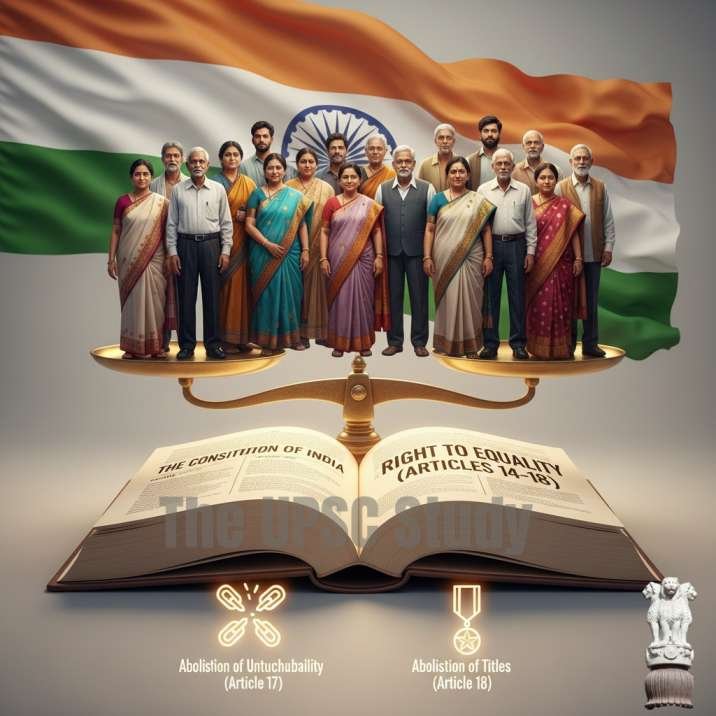
Article 17: Abolition of Untouchability.
(a) “Untouchability” is abolished and its practice in any form is forbidden. The enforcement of any disability arising out of “Untouchability” shall be an offence punishable in accordance with law.
Article 17 mandates the abolition of “Untouchability” and strictly forbids its practice in any form. The enforcement of any disability resulting from “Untouchability” is a punishable offence.
Legislative and Judicial Action
- Legislation: Parliament enacted the Untouchability (Offences) Act, 1955. This Act was later amended and renamed in 1987 as the Protection of Civil Rights Act, 1955, primarily to make the laws against untouchability more stringent.
- Scope (PUDR Case): In People’s Union for Democratic Rights vs. Union of India (1982), the Supreme Court ruled that the right under Article 17 is enforceable against both the State and private individuals. Consequently, the State must take action against such violations.
- Definition: The Constitution itself does not define “Untouchability.” The Supreme Court interpreted it as referring to the “social practice which looks down upon certain depressed classes solely on account of their birth” and disables them from having “any kind of intercourse with people belonging to higher castes.”
Examples of Prohibited Practice
Untouchability is understood through actions like:
- Preventing access to any place of public worship, ghats, wells, tube wells, water, and other public facilities (which also touches upon the right against discrimination).
- Refusing services from places like hospitals, dispensaries, or educational institutes.
- Denying access to any shop, hotel, restaurant, or public place.
- Insulting a person belonging to a Scheduled Caste (SC) or Scheduled Tribe (ST).
- Spreading untouchability based on the ground of history or religion.
Strengthening Protective Legislation
As the Protection of Civil Rights Act, 1955, and the Indian Penal Code (IPC) were deemed insufficient to protect SCs and STs from offences, Parliament passed the:
- Scheduled Caste and Scheduled Tribe (Prevention of Atrocities) Act in 1989.
- Prohibition of Employment as Manual Scavengers and their Rehabilitation Act in 2013, which seeks to enforce the fundamental right of manual scavengers against untouchability when read together with Article 14, 19, and 21 (the Golden Triangle of Fundamental Rights in Indian Constitution).
(fundamental rights in Indian constitution)
Article 18: Abolition of titles
- State shall not confer any title except military or academic. The hereditary title like maharaja, Raj Bahadur, Raibahadur were abolished.
- No citizen of India shall accept any title from any foreign state.
- A foreigner holding any office of profit or trust under the state cannot accept any title from any foreign state without the consent of President.
- No citizen or foreigner holding any office of profit or trust under the state shall, without the consent of the President, accept any present, emolument, or office of any kind from or under any foreign state.
In 1954, the government of India introduced 4 awards like Bharat Ratna, Padma Vibhushan, Padma Bhusan and Padma Shri. Bharatratna was to be awarded for “exceptional services in the field of art, literature and science, and in recognition of public service of higher order”. The others would be awarded for distinguished public services in any field.
The Janata Party government headed by Morarji Desai discontinued them in 1977. It prohibited all these awards on the ground of violation of Article 18.
In Balaji Raghavan Case VS Union of India, 1996, the supreme court upheld the validity of these awards. It ruled that award do not amount to ‘title’ within the meaning of Article 18. These awards merely denote the state’s recognition of good work by citizens in various field of activities. However, it also ruled that they should not be used as suffix or prefixes to name of awardees.
So all the award again restored by Supreme Court verdict in Indira Gandhi government regime since 1980.
(fundamental rights in Indian constitution)
Next blog is on explaining the further articles of fundamental rights in Indian Constitution.
(fundamental rights in Indian constitution)