India US Bilateral Relations
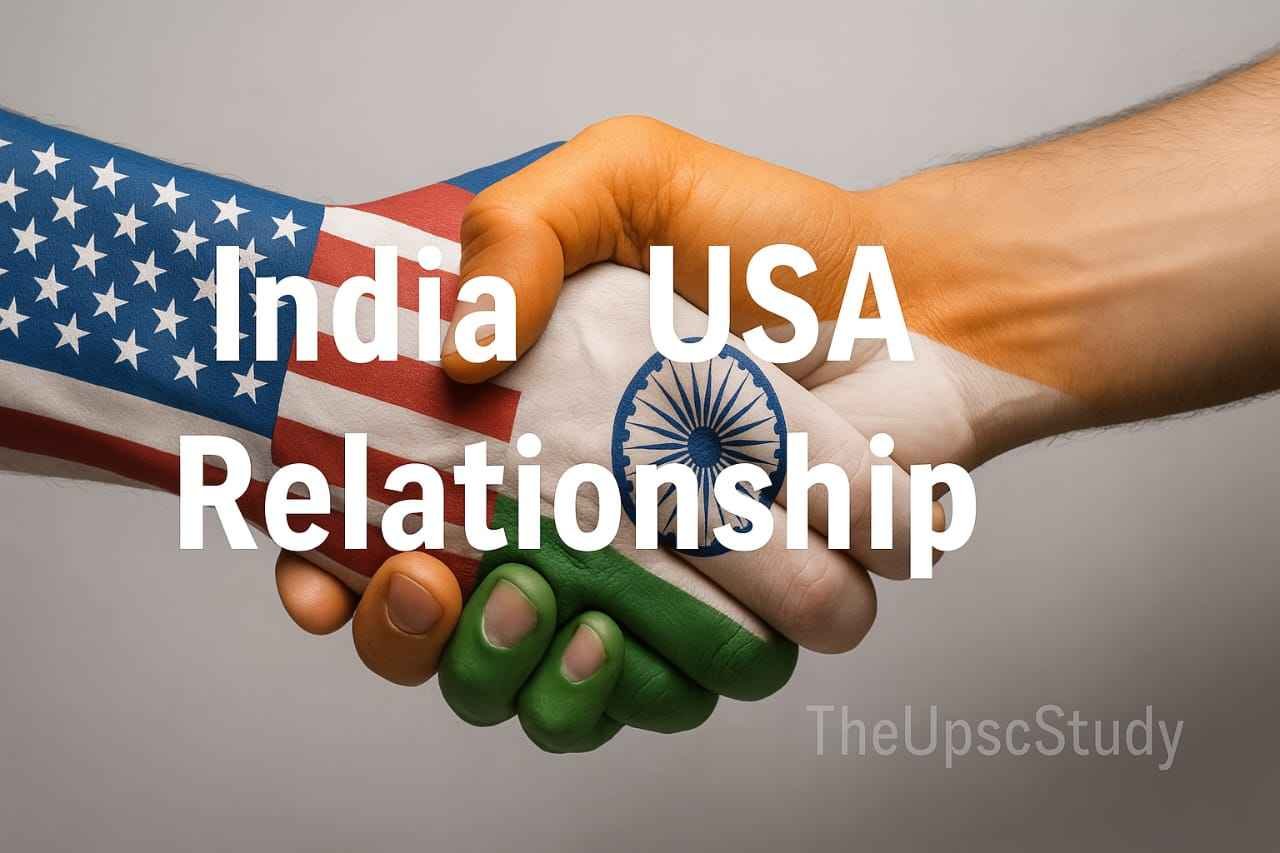
India and the United States share a global strategic partnership that is founded on their common democratic values and an increasing alignment of interests across bilateral, regional, and global platforms. Over the years, the relationship has expanded beyond diplomacy into areas such as defense, governance, development, and strategic cooperation.
Table of Contents
🔔Foundations of the Partnership
📢India US Relations: Trade War, Strategic Ties & Challenges
India and the United States share a comprehensive global strategic partnership rooted in democratic values, economic ties, and regional cooperation. Over time, India US relations have expanded across defence, technology, climate, education, and security. However, recent tensions, particularly the trade war under Trump’s second term, have raised new challenges for this partnership.
📢Historical Background of India US Relations
India US ties have evolved from initial mistrust during the Cold War to strong cooperation in the 21st century. Key milestones include:
- 2008 Civil Nuclear Deal (123 Agreement), a turning point in strategic trust.
- 2016 “Enduring Global Partners” statement, recognising long-term cooperation.
- 2023 iCET Initiative for critical technology and defence.
This background sets the stage for both opportunities and frictions.
🔔Trade War and Economic Tensions
🔊 Trump’s Tariff War 2025
In 2025, the US administration under President Trump imposed sweeping tariffs on imports. India was hit with:
- 26% tariff in April 2025 under “Liberation Day Tariffs.”
- Additional 25% reciprocal tariff in August 2025, raising total duties to 50%.
These moves targeted India’s continued oil trade with Russia and created friction in bilateral ties.
🔊 Impact on India’s Economy
- According to HDFC Bank, tariffs could reduce India’s GDP growth by 0.4–0.5%.
- Bank of Baroda projected a 0.3–0.8% slowdown in FY 2025–26.
- Trade surplus (India exports more to US) may shrink due to reduced competitiveness.
🔊 Mission-500 Trade Target
Despite tensions, both countries had launched Mission-500, aiming to double trade to $500 billion by 2030. By March 2025:
- Bilateral trade: $120 billion
- India exports: $77 billion
- Imports from US: $42 billion
The tariffs threaten this vision, raising questions about future trade flows.
2026 Interim India US Bilateral Agreement
On February 7, 2026, India and the U.S. announced an interim trade agreement reducing a strained India US relations post 2025. Simultaneously, President Trump signed an executive order removing the 25% penalty tariff on Indian goods and establishing a reduced rate of 18%. This came immediately after India-EU FTA.
Trade Provisions
India will eliminate or reduce tariffs on all U.S. industrial goods, alongside tree nuts, fresh fruits, soybean oil, and spirits. Conversely, the U.S. will apply the reduced 18% rate to Indian textiles, leather, and chemicals. High-value items such as generic pharmaceuticals, gems, diamonds, aircraft parts, and spices have been granted zero-duty access.
The agreement also addresses non-tariff barriers and promotes technology cooperation, including ICT, medical devices, AI data-centres and GPU trade.
Exclusions
To safeguard India’s domestic agriculture, wheat, rice, maize, sugar, dairy, and poultry remain excluded from the deal. Furthermore, genetically modified (GM) foods, ethanol, and tobacco will not receive any tariff relief.
This can be observed as early steps to final Bilateral Agreement between India US relations.
🔔Defence and Security Cooperation
While trade faces hurdles, defence cooperation remains a strong pillar.
📌 Foundational Agreements
- LEMOA (2016): Reciprocal logistics support.
- COMCASA (2018): Secure communications.
- BECA (2020): Sharing geospatial data.
📌 Military Exercises
- Yudh Abhyas (Army)
- Malabar (Navy, with Japan & Australia under QUAD)
- Cope India (Air Force)
- Tiger Triumph (Tri-services)
These enhance interoperability but also raise concerns in India about maintaining strategic autonomy.
🔔QUAD and Indo-Pacific Strategy
The Quadrilateral Security Dialogue (QUAD)—India, US, Japan, Australia—has become central to Indo-Pacific geopolitics.
📍 Key Objectives:
- Uphold a Free and Open Indo-Pacific (FOIP).
- Promote maritime security and freedom of navigation.
- Build resilient supply chains in semiconductors and rare earths.
- Collaborate on climate change and vaccines.
QUAD positions India and the US as critical partners in countering China’s growing assertiveness.
🔔Technology & Innovation Partnership
🎓 iCET & COMPACT Framework
- iCET (2023): Collaboration in AI, semiconductors, quantum, nanotech.
- COMPACT (2025): Defence innovation and autonomous systems.
🎓 TRUST Framework
Aims at long-term cooperation in emerging tech through government, academia, and industry partnerships.
These initiatives position India US relations as key drivers of global technological transformation.
🔔Nuclear Cooperation
The 123 Civil Nuclear Agreement (2008) reshaped ties but faced challenges due to India’s Civil Liability for Nuclear Damage Act (2010).
- US companies feared liability risks, delaying projects.
- In 2025, US approved transfer of SMR (Small Modular Reactor) technology to India.
- However, liability concerns continue to stall nuclear collaboration.
🔔Cooperation Against Terrorism
India and the US share a strong stance against terrorism:
- Joint support in UNSC Resolution 2593 (Afghanistan, 2021).
- Both designate groups like LeT, JeM, HuJI, Hizbul Mujahideen as terrorist organisations.
- In 2025, The Resistance Front (TRF) was designated by both countries after the Pahalgam attack.
This counter-terrorism partnership reinforces India’s demand for global action against Pakistan-sponsored groups.
🔔I2U2: Minilateral Diplomacy
The I2U2 grouping (India, Israel, UAE, US) reflects a new model of West Asian cooperation.
- Focus areas: food security, water, energy, technology.
- Enhances India’s strategic role in West Asia.
- Complements QUAD by linking geo-economics with geopolitics.
🔔Issues in India US Relations
💡 1. Trade Barriers
- Tariff disputes remain the biggest hurdle.
- US pressure on India to lower tariffs on luxury goods.
💡 2. IPR Disputes
- US Special 301 Report criticises India’s IPR enforcement.
- India defends its approach to protect traditional knowledge.
💡 3. Visa Restrictions
- H-1B visa curbs hit Indian IT professionals.
💡 4. CAATSA Sanctions Threat
- India’s purchase of Russian S-400 system risks US sanctions.
💡 5. Human Rights Concerns
- US often raises civil liberties issues in India, which New Delhi sees as interference.
🔔Wayforward
💎 India US relations have grown into a vital global partnership covering defence, trade, technology, and regional security, yet trade frictions and tariff wars continue to test the ties. India must resolve such disputes bilaterally through diplomatic channels while upholding its principles of strategic autonomy—pursuing national interests independently within a rules-based order. To cushion the impact of US tariff barriers, India should diversify trade by fast-tracking FTAs with partners such as the UK, EU, EFTA, GCC, and BIMSTEC, while leveraging trade corridors like INSTC and IMEC for long-term energy and connectivity security.
💎 As a leading voice of the Global South, India’s role in the Indo-Pacific—through initiatives like SAGAR, the Indo-Pacific Oceans Initiative (IPoI), QUAD, and I2U2—underscores its commitment to a free, open, and inclusive region. Ultimately, the way forward lies in balancing great power rivalries, deepening strategic cooperation with the US, expanding economic partnerships with other global actors, and ensuring that every step in foreign policy serves India’s national interest and people’s welfare.
🔔Conclusion
The India US relations stand at a crossroads. While defence, technology, and security cooperation continue to deepen, the 2025 trade war has created economic frictions that could impact long-term trust. Balancing these contradictions while strengthening mutual interests will determine whether the partnership truly evolves into the “defining relationship of the 21st century.”